All-solid-state batteries (ASSBs) replace the liquid electrolyte in conventional lithium-ion cells with a solid ionic conductor. In theory, this enables lithium-metal anodes, higher energy density, and better thermal stability. In practice, demonstrated lab performance still trails those projections significantly, constrained by solid-solid interface resistance, mechanical strain during cycling, and manufacturing costs that remain well above current Li-ion. As of 2026, the main gap is between the energy density and cycle-life potential shown in models and the performance demonstrated in commercially relevant cells. It is the primary reason ASSBs are unlikely to reach consumer smartphones before the late 2020s at the earliest.
Conventional lithium-ion cells use a liquid organic electrolyte, typically a lithium salt dissolved in an ethylene or dimethyl carbonate solvent, to shuttle ions between a graphite anode and a metal-oxide cathode. That liquid enables good room-temperature ionic conductivity (~10 mS/cm) but is flammable, requires a physical separator to prevent short circuits, and has historically favored graphite-based anodes, which have a theoretical specific capacity of 372 mAh/g, a ceiling that incremental engineering improvements have largely reached.
ASSBs replace that liquid-electrolyte architecture with a solid ionic conductor, a change that theoretically enables lithium-metal anodes, higher energy density, and reduced flammability risk. Realizing those advantages at commercial scale depends on solving a set of materials and manufacturing problems that remain open as of 2026.
This article examines how ASSBs work at the materials level, compares their performance against incumbent lithium-ion technology, and assesses what solid-state integration could mean for smartphone hardware design. Throughout, performance figures are categorized as theoretical values, laboratory demonstrations, or company-reported claims, each treated differently. Company claims are identified as such and are not presented as independently validated results. The commercialization timeline discussed in the final section reflects our own analysis of current manufacturing readiness and industry roadmaps, not an established industry consensus.
What Is a Solid-State Battery, and How Does It Differ from Lithium-Ion?
To understand what changes in a solid-state battery, you first need a precise picture of what it replaces.
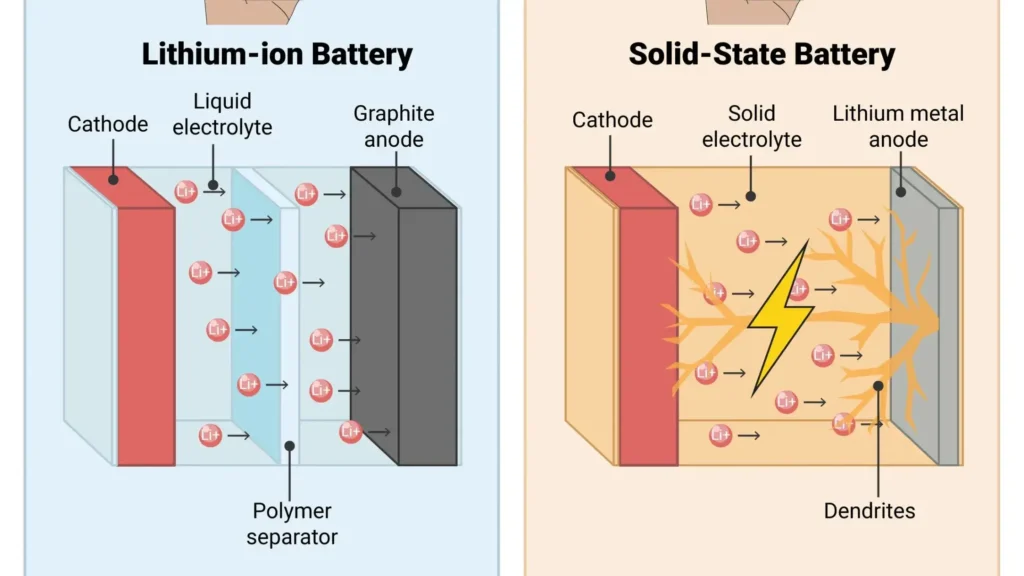
A conventional lithium-ion cell consists of four primary components: a graphite anode, a metal-oxide cathode (typically LCO, NMC, or LFP chemistry), a porous polymer separator, and a liquid electrolyte, generally a lithium salt dissolved in an organic carbonate solvent. During discharge, lithium ions deintercalate from the graphite anode, migrate through the liquid electrolyte, and intercalate into the cathode. The separator physically prevents the electrodes from touching while allowing ionic transit. The liquid electrolyte provides the ionic conductivity pathway, typically around 10 mS/cm at room temperature.
Graphite’s theoretical specific capacity is 372 mAh/g, a ceiling that incremental engineering has largely reached, as explored in our overview of how silicon-carbon anodes push beyond graphite’s limits.
In an all-solid-state battery, the liquid electrolyte and separator are replaced entirely by a solid ionic conductor. That swap changes the anode chemistry, the thermal behavior, the allowable form factor, and the manufacturing process all at once.
Solid Electrolyte Materials: Sulfides, Oxides, and Polymers
No single solid electrolyte material has emerged as the universal solution. The three primary classes each involve distinct trade-offs.
Sulfide-based electrolytes
Sulfide-based electrolytes, particularly argyrodite compounds (Li₆PS₅Cl) and LGPS (Li₁₀GeP₂S₁₂), currently lead the field in measured ionic conductivity. LGPS, first reported by Kamaya et al. in a 2011 Nature Materials paper (DOI: 10.1038/nmat3066), achieves a room-temperature ionic conductivity of 12 mS/cm, a figure that meets or exceeds typical liquid electrolytes and, according to a 2025 review in Physics Today, is the benchmark that any competitive solid electrolyte must approach.
That conductivity advantage makes sulfides the leading candidate electrolyte class for high-rate applications such as fast charging. The practical liabilities are chemical instability and a narrow electrochemical window: sulfide electrolytes react with atmospheric moisture during processing. They are incompatible with several high-voltage cathode chemistries without additional interfacial coating layers.
Oxide-based electrolytes
Oxide-based electrolytes, most prominently LLZO (Li₇La₃Zr₂O₁₂) and LiPON (lithium phosphorus oxynitride), offer greater chemical stability and a wider electrochemical window than sulfides. LLZO’s mechanical rigidity also suppresses lithium dendrite formation more effectively under many conditions.
The conductivity trade-off is significant: LLZO typically achieves 0.1–1 mS/cm at room temperature, well below LGPS a gap that requires elevated operating temperatures or nanoscale engineering to close, per the 2025 Physics Today review. At the demonstrated cell level, Ganfeng Lithium reported 260 Wh/kg in its first-generation oxide-ceramic solid-state cells, a company-reported figure, not independently peer-reviewed, but notable as an early commercial data point.
Polymer electrolytes
Polymer electrolytes, often poly (ethylene oxide)-based systems, are mechanically flexible and compatible with roll-to-roll manufacturing, significant advantages for smartphone form factors. The fundamental problem is temperature: most polymer electrolytes only achieve adequate ionic conductivity above approximately 80°C, which disqualifies them for ambient-temperature consumer electronics without significant reformulation. Composite polymer-ceramic approaches are being researched to close this gap.
Ion Transport at the Solid-Solid Interface
In liquid electrolytes, ionic transport benefits from molecular mobility; lithium ions diffuse freely through solution. In a solid electrolyte, lithium ions hop between lattice sites via vacancy or interstitial mechanisms. This works well within the bulk electrolyte, but the solid-solid interface between the electrolyte and electrode introduces unique complications.
Lattice mismatch, chemical interdiffusion, and space-charge layers at the electrode-electrolyte interface create high interfacial impedance. Managing this interface through coating layers, interlayers, and surface passivation is one of the central research problems in ASSB development and a primary reason lab cycle life currently underperforms theoretical projections.
How Do All-Solid-State Batteries Compare to Lithium-Ion on Key Metrics?
Energy Density: Theoretical vs. Lab-Demonstrated
Conventional lithium-ion batteries currently achieve 100–265 Wh/kg gravimetrically, depending on chemistry and form factor. Replacing the graphite anode with lithium metal and the liquid electrolyte with a solid ionic conductor theoretically enables approximately 40% higher energy density by weight and approximately 70% higher by volume at the cell-level figures cited in the 2025 Physics Today review by Muy, Hatzell, Meng, and Shao-Horn (DOI: 10.1063/pt.3d9e5d0853).
The frequently cited 2–2.5x headline improvement is a separate, material-level estimate derived from the theoretical specific capacity difference between lithium metal (3,860 mAh/g) and graphite (372 mAh/g); it should not be conflated with what a complete cell stack would deliver. At the demonstrated cell level, Ganfeng Lithium’s first-generation oxide-ceramic solid-state cells achieved 260 Wh/kg, a company-reported figure that represents a modest step beyond advanced Li-ion rather than a doubling of energy density. Projections of 350–400 Wh/kg at the cell level remain modeled targets, not independently validated results.
The source of that gain is the lithium-metal anode. Lithium metal’s theoretical specific capacity is 3,860 mAh/g, more than ten times graphite’s 372 mAh/g. Pairing that anode with a solid electrolyte can reduce some of the risks that made lithium-metal anodes impractical in liquid electrolyte cells, specifically the likelihood of dendrites shorting through a soft polymer separator. But solid electrolytes do not eliminate the dendrite problem; they change its failure mode from electrochemical dissolution to mechanical fracture, as discussed in the Engineering Challenges section below. In practice, interface resistance and mechanical strain mean current lab demonstrations fall well short of theoretical maxima.
Thermal Stability
Liquid organic electrolytes are flammable. Thermal runaway, the exothermic chain reaction triggered by internal short circuits, overcharging, or external heat, is a genuine safety risk in Li-ion cells and a significant constraint on how fast-charging standards are engineered for smartphones.
Solid electrolytes are non-flammable and thermally stable at temperatures that cause liquid electrolyte decomposition. That changes the flammability risk profile and shifts some thermal-management constraints on charging rate, but it does not remove them. Charging performance in ASSBs remains bounded by ionic transport through the solid electrolyte, interfacial resistance at the solid-solid junction, heat generation during high-rate lithium plating, and the mechanical behavior of electrode and electrolyte materials under sustained current loads.
Cycle Life
Conventional Li-ion cells in smartphones typically sustain 500–1,000 full charge cycles before capacity degrades to 80% of original capacity, a figure based on real-world commercial performance across NMC and NCA chemistries. LFP chemistry, as used in some Android devices and most stationary storage, extends this to approximately 4,000 cycles under standard conditions. ASSBs are theoretically projected to reach 10,000+ cycles, based partly on the expectation that solid electrolytes reduce the growth of lithium-consuming interphases at the anode.
However, this is not a simple elimination: all-solid-state batteries can still form interphases at electrode/solid-electrolyte interfaces, and the dynamics of those interphases differ by electrolyte class and are not fully characterized at commercial scale. That 10,000-cycle projection has not been validated at commercial cell sizes. Published lab results for ASSBs frequently demonstrate fewer cycles than LFP under comparable test conditions, a consequence of mechanical degradation at solid-solid interfaces rather than electrochemical capacity fade alone, indicating that the theoretical longevity advantage remains a modeling output, not a demonstrated result.
What Could All-Solid-State Batteries Change About Smartphone Hardware?
For smartphones specifically, the most significant potential changes are physical thickness, charging behavior, and battery longevity.
Form factor and thinner designs
Eliminating the separator and replacing liquid electrolyte with a thin solid-electrolyte layer allows cell stacks to be compressed further. Bipolar stacking architectures, impractical with liquid electrolytes due to leakage risks, become viable. This could reduce battery module thickness meaningfully, relevant for ultra-thin smartphone designs and foldables where z-height is the dominant constraint.
Faster charging with reduced flammability risk
The thermal stability of solid electrolytes can ease some of the flammability and heat-dissipation constraints that currently shape how smartphone fast-charging standards are engineered and certified. Sulfide-based cells with high ionic conductivity (LGPS at 12 mS/cm) theoretically support higher charge rates than liquid electrolyte cells where thermal runaway is a hard boundary. In practice, charge rate in ASSBs is still constrained by ionic transport through the solid electrolyte, interfacial resistance at the solid-solid junction, and heat generated during high-rate lithium plating; bringing that interfacial resistance down to workable levels at production scale remains an unsolved problem.
Longevity and power consumption alignment
If ASSB cycle life projections hold at commercial scale, a smartphone battery could outlast the device itself, eliminating battery degradation as a driver of device replacement. Paired with efficiency gains from how modern smartphone displays and processors manage power draw, this could meaningfully extend the usable lifespan of a device. That changes after-market service economics and aligns with right-to-repair frameworks requiring durable battery design.
Engineering Challenges Preventing Immediate Commercialization
Current ASSB performance is limited by several engineering problems: solid-solid interface resistance, mechanical strain from electrode volume changes, dendrite-driven electrolyte fracture, high manufacturing costs, and electrochemical window constraints. Each is discussed below.
Solid-Solid Interface Resistance and Contact Loss
Solid electrolytes cannot conform to electrode surfaces the way liquid electrolytes do. As cells cycle, mechanical contact between electrode and electrolyte degrades, increasing interfacial resistance and accelerating capacity fade. Maintaining intimate solid-solid contact across thousands of cycles while both electrode and electrolyte expand and contract requires either external stack pressure (impractical at consumer scale) or material engineering solutions not yet ready for production.
The Dendrite Problem: New Clarity from 2026 Research
Lithium dendrites, filamentary lithium deposits that grow through the electrolyte during charging, were expected to be suppressed by solid electrolytes, particularly ceramic ones like LLZO. The reality is more nuanced. A 2026 study from the Max Planck Institute for Sustainable Materials (MPI-SusMat), published in Nature (DOI: 10.1038/s41586-026-10415-9), provides direct evidence for a mechanically driven penetration mechanism in garnet-type solid electrolytes: hydrostatic stress generated at the lithium-metal anode during deposition drives tensile fracture of the ceramic electrolyte, creating grain-boundary pathways through which lithium filaments propagate.
This is distinct from the electrochemical dissolution process responsible for dendrite growth in liquid electrolytes. The study does not resolve every failure mode across all solid electrolyte classes. Still, its findings indicate that for garnet electrolytes specifically, higher electrolyte fracture toughness and controlled stack pressure are the primary engineering levers, not electrolyte chemistry alone.
Volume Changes and Mechanical Strain
The lithium-metal anode undergoes 15–30% volume change during charge-discharge cycling. Cathode materials typically change 1–5% by volume. These mismatched deformations generate mechanical stress at every interface in the cell stack. For brittle ceramic electrolytes, repeated stress cycling leads to cracking and contact loss. For polymer electrolytes, creep and delamination are the failure modes. In publicly demonstrated commercial-scale results, no electrolyte class has shown a reliable solution to this problem across commercially relevant cycle counts.
Manufacturing Scalability and Cost
Oxide ceramic electrolytes require high-temperature sintering (often above 1,000°C), precise atmospheric control, and processes incompatible with existing Li-ion production infrastructure. Sulfide electrolytes demand moisture-free environments throughout manufacturing. These requirements drive production costs significantly above current Li-ion cells. ProLogium Technology inaugurated its Taoyuan solid-state cell facility in January 2024; the company describes it as the world’s first ASSB gigafactory, with a planned capacity of 2 GWh. ProLogium has reported shipping more than 800,000 cells from that facility, though the cells are automotive-grade pouch formats; no consumer-electronics or smartphone product integration timeline has been disclosed, and production cost per Wh has not been published.
Temperature Sensitivity
At sub-zero temperatures, ionic conductivity in solid electrolytes drops sharply. Polymer electrolytes are particularly affected, but even superionic conductors like LGPS show meaningful conductivity reduction at temperatures common in outdoor smartphone use in cold climates. Li-ion cells also underperform in cold, but the degradation curve for some ASSB chemistries is steeper.
Electrochemical Window Limitations
The electrochemical window of a solid electrolyte defines the voltage range over which it remains chemically stable, neither oxidizing nor reducing. Sulfide electrolytes, despite their conductivity advantages, have narrow electrochemical windows that restrict cathode selection (high-voltage cathodes like LNMO are problematic) or require protective coating layers that add complexity and cost. Oxide electrolytes have wider windows but lower conductivity. No solid electrolyte currently offers all three: high conductivity, wide electrochemical window, and mechanical toughness.
Also Read: iQOO X: 15,000mAh Battery, Snapdragon 8 Elite Gen 10 Pro, Specs & Feasibility Analysis
ASSB Commercialization Timeline: When Could Solid-State Batteries Reach Consumer Smartphones?
Where Leading Manufacturers Stand in 2026
Samsung SDI
Samsung SDI has publicly targeted mass production of its SolidStack all-solid-state battery for the second half of 2027, with automotive applications as the primary initial market. Samsung SDI has not published a timeline for smartphone-grade cells; any consumer electronics follow-on is an inference based on the broader industry pattern in which automotive qualification precedes consumer electronics integration, not a commitment the company has made publicly. How quickly that transition occurs will depend on whether the company meets its 2027 automotive production milestone, a target that itself reflects years of compressed development.
Toyota
Toyota has publicly targeted commercialization of its all-solid-state battery technology between 2027 and 2028, a timeline the company reiterated in 2025 materials covering its collaboration with Sumitomo Metal Mining. Whether Toyota meets that window depends on resolving the same interface and manufacturing challenges facing the broader industry; the company has acknowledged those difficulties without formally revising its official target as of mid-2026.
QuantumScape & Solid Power
QuantumScape and Solid Power are developing sulfide and separator-based solid-state cells primarily for electric vehicles, with consumer electronics applications downstream of automotive validation.
ProLogium
ProLogium inaugurated its Taoyuan solid-state cell facility in January 2024; the company describes it as the world’s first ASSB gigafactory, with a planned capacity of 2 GWh. ProLogium has reported shipping more than 800,000 cells from that facility, though the cells are automotive-grade pouch formats rather than consumer electronics configurations. The company’s published technology roadmap references consumer electronics as a future application area, but no smartphone-specific integration timeline, cell format specification, or cost target has been disclosed publicly.
Evaluating extraordinary battery claims: the Donut Labs case
When a company reports cell-level performance of 400 Wh/kg, 5-minute full charge capability, and 100,000-cycle life as Donut Labs has done, those figures are useful primarily as a test case for how to assess battery-company claims, not as evidence of a validated breakthrough. None of those numbers have appeared in peer-reviewed literature or been confirmed by independent third-party testing. They are company-reported claims, and should remain unverified until the underlying methodology is publicly available for scrutiny and independent replication has been attempted.
Realistic Timeline for Smartphone Integration
Automotive qualification programs are widely understood to span multiple years before a cell chemistry transitions into consumer electronics, a pattern visible across prior Li-ion generations, but a specific, sourced cycle-time figure for ASSBs is not yet available given how early most programs are. Smartphone integration requires cells thin enough for mobile form factors, stable performance across -20°C to 60°C, and production costs competitive with advanced Li-ion.
Based on current manufacturing yield, interfacial engineering progress, and the assumption that automotive-scale production problems are resolved before consumer electronics qualification begins, we assess that 2028–2030 represents a plausible window for early ASSB adoption in premium consumer smartphones, not an established industry consensus. That estimate could slip further if interface resistance and ceramic fracture challenges take longer to resolve than current roadmaps assume. Mid-range adoption would follow by several additional years under any scenario.
The intermediate pathway is hybrid architectures with solid-electrolyte layers and lithium-metal anodes but conventional cathode materials that capture some density benefit while reducing interfacial complexity. Several research groups are pursuing this approach as a near-term bridge.
What the Evidence Currently Supports
ASSBs differ from lithium-ion batteries primarily in the electrolyte: replacing the liquid organic solvent with a solid ionic conductor enables a lithium-metal anode, which raises theoretical specific capacity from 372 mAh/g (graphite) to 3,860 mAh/g and removes the flammable liquid from the cell stack. Those are real structural changes with real performance implications, but both depend on solving the interfacial and mechanical problems described above before they translate into commercially demonstrated results.
The 2026 MPI-SusMat findings replace a vague assumption that solid electrolytes suppress dendrites with a specific failure mechanism: mechanically driven fracture along garnet grain boundaries caused by hydrostatic stress at the lithium-metal anode. That mechanistic specificity points to electrolyte fracture toughness and stack pressure as the engineering variables to target. Interface resistance, ceramic fracture mechanics, and manufacturing cost at scale remain the three open problems separating current lab results from commercial viability.
Four metrics will indicate ASSB smartphone readiness more reliably than headline Wh/kg figures: demonstrated cycle life at commercially relevant cell sizes, interfacial resistance under realistic charge-discharge loads, manufacturing yield on ASSB-specific production lines, and cost per Wh relative to advanced Li-ion. Whether and when those numbers converge with Li-ion benchmarks remains an open question.
Frequently Asked Questions (FAQ’s) About All-Solid-State Batteries
What is the main difference between an all-solid-state battery and a lithium-ion battery?
The primary structural difference is the electrolyte. Lithium-ion batteries use a liquid electrolyte, typically a lithium salt in an organic carbonate solvent, alongside a porous polymer separator. All-solid-state batteries replace both with a single solid ionic conductor. This enables use of a lithium-metal anode (specific capacity: 3,860 mAh/g vs. graphite’s 372 mAh/g) and eliminates the flammable electrolyte, but introduces solid-solid interfacial resistance and mechanical strain challenges.
Which solid electrolyte material has the highest ionic conductivity?
LGPS (Li₁₀GeP₂S₁₂), a sulfide-based superionic conductor first reported in 2011, achieves 12 mS/cm at room temperature, exceeding typical liquid electrolytes (~10 mS/cm). However, LGPS has a narrow electrochemical window and reacts with moisture, complicating manufacturing and cathode compatibility.
Why do lithium dendrites still form in solid-state batteries if there’s no liquid electrolyte?
Research has shown that dendrite propagation in ceramic solid electrolytes occurs through a different mechanism than in liquid electrolytes. A 2026 study from MPI-SusMat published in Nature demonstrated that hydrostatic stress at the lithium-metal anode causes brittle fracture of ceramic electrolyte grains, creating physical channels through which lithium filaments propagate. The solution requires improving electrolyte fracture toughness and controlling stack pressure, not just changing electrolyte chemistry.
When will all-solid-state batteries appear in consumer smartphones?
No mainstream smartphone ships with an ASSB as of mid-2026, and no manufacturer has published a consumer-electronics cell timeline. Samsung SDI targets automotive ASSB mass production by late 2027; Toyota’s publicly stated commercialization target remains 2027–2028, reiterated in 2025 materials. Based on the historical pattern in which automotive qualification has preceded consumer electronics integration across prior battery generations a pattern, not a published commitment from any ASSB manufacturer we assess that 2028–2030 represents a plausible window for early adoption in premium smartphones. That is an editorial inference, not an established industry consensus.
Are ASSB energy density claims of 400+ Wh/kg credible?
Ganfeng Lithium has reported 260 Wh/kg in first-generation oxide-ceramic solid-state cells, a company-reported figure, not independently peer-reviewed. A 2025 Physics Today review cites a theoretical cell-level improvement of approximately 40% by weight over conventional Li-ion with a solid electrolyte and lithium-metal anode; applied to the upper range of current Li-ion (~265 Wh/kg), that yields, by our calculation, roughly 370 Wh/kg as a modeled target, not a demonstrated result. Claims of 400 Wh/kg with 100,000 cycles, such as those from Donut Labs, have not appeared in peer-reviewed literature or been independently verified and should be treated as unvalidated until that data is published.
What makes manufacturing all-solid-state batteries difficult?
Oxide ceramic electrolytes require sintering above 1,000°C and precise atmospheric control. Sulfide electrolytes must be processed entirely in dry-room or inert-atmosphere conditions. Both are incompatible with standard Li-ion manufacturing infrastructure. The volume mismatch between lithium-metal anode (15–30% change per cycle) and cathode (1–5%) also demands new cell design approaches to prevent mechanical failure. ProLogium’s Taiwan gigafactory, commissioned in 2024, is the first ASSB-dedicated large-scale production facility, but cost per Wh remains non-competitive with advanced Li-ion at scale.
Sources: Science Daily, Flash Battery, BioLogic, Physics Today

Author Bio
Abhijeet Shrivastava is a content writer at WriNews, where he covers smartphones, computers, laptops, electrical appliances, and a wide range of electronic and electrical components. With an academic background in Computer Science and additional knowledge and hands-on training in electrical systems and components, he brings both technical understanding and practical experience to his writing.
Alongside his work in content creation, Abhijeet serves as an assistant teacher at a school in Pune, combining his interest in technology with a passion for learning and education. He also runs his own workshop, where he regularly experiments with, repairs, and tinkers with electronic and electrical components. This hands-on experience helps him approach technology topics from both a practical and technical perspective.
Through his work, Abhijeet aims to make complex technology easier to understand while providing useful, accurate, and practical information for readers.