Snapdragon 8 Elite Gen 6 Pro: Leaked Specs, AnTuTu Score & AI Frame Fusion
Abhijeet Shrivastava
August 21, 2026
Qualcomm’s mobile chip roadmap hasn’t looked this consequential in years. The Snapdragon 8 Elite Gen 6 Pro, internally designated SM8975, is the first chipset rumored to combine a 2nm-class process node with a GPU that reportedly runs AI inference in parallel with rendering, and leaked benchmark scores already clear the bar set by today’s fastest Android phones.
If even half of the reported specs hold up, it marks a genuine shift in how AI workloads are handled on mobile silicon. That said, none of it is official. Qualcomm has not announced the Gen 6 Pro, and no official spec sheet exists. Everything below is drawn from pre-release leaks, supply chain reporting, and internal documentation reviewed by third-party publications. Claims are labeled throughout as Reported (corroborated across multiple named outlets), Leaked (single source or unverified screenshot), or Analysis (our interpretation of the evidence).
Primary sources: Weibo tipster Digital Chat Station (DCS); Fixed Focus Digital; Notebookcheck internal graphics documentation (July 27, 2026); Beebom Gadgets, Wccftech, GSMArena, Gizmochina, VideoCardz, and PhoneArena.
The table below divides specifications by confidence level. Higher-confidence items are based on corroborated reporting; lower-confidence items come from single sources and should be treated with additional caution.
High confidence (reported across multiple outlets)
SpecificationClaimed ValueSource
Specification
Claimed Value
Source
Internal model number
SM8975
DCS, multiple outlets
Process node
TSMC N2P (2nm-class)
Beebom, Gizmochina
CPU configuration
2+3+3 Oryon
DCS, Fixed Focus Digital
GPU
Adreno 850
Multiple outlets
GPU GMEM (Pro)
18MB
VideoCardz, Beebom
GPU GMEM (standard Gen 6)
12MB, Adreno 845
Multiple outlets
Memory support
LPDDR6 or LPDDR5X
Gizmochina, Beebom
Medium confidence (leaked or single-corroborated)
Specification
Claimed Value
Source
Prime core clock speed
~4.8–5.0 GHz
Beebom (benchmark metadata)
Matrix ALUs in GPU
2 units in shader processor
Notebookcheck, Jul 27, 2026
AI Frame Fusion
Super-resolution + frame generation
VideoCardz, Jul 27, 2026
Low confidence (single source; treat with caution)
Storage (UFS 5.0), modem (Snapdragon X105), connectivity (Wi‑Fi 8 / Bluetooth 7.0 / UWB via FastConnect 8800), die size (~134 mm²), and chipset cost ($300+) are each reported by Beebom or Gizmochina without corroboration in the other sources used here. They are noted for completeness but should not be treated as confirmed.
Qualcomm has confirmed none of these specifications.
Snapdragon 8 Elite Gen 6 Pro: Process Node and CPU
Reported. Multiple outlets, including Gizmochina (March 25, 2026) and Beebom Gadgets, report that both the SM8975 and standard SM8950 are built on TSMC’s N2P node, a 2nm-class process using gate-all-around (GAA) nanosheet transistors. TSMC’s N2P specifications are publicly documented; Qualcomm has not confirmed the fab partner. An earlier GSMArena report noted Samsung was also in contention.
Reported. DCS and Fixed Focus Digital both report a 2+3+3 Oryon CPU cluster: two prime cores, three performance cores, and three efficiency cores. This configuration is reported for both the Pro and standard Gen 6 variants, meaning the CPU cluster is not the primary differentiator between the two chips. Fixed Focus Digital also indicated CPU performance gains over the Gen 5 would be less than 20%.
Leaked. Prime core clock speeds of 4.8–5.0 GHz are reported by Beebom based on early benchmark metadata. For context, the Gen 5 peaks at 4.61 GHz standard and 4.74 GHz on the Samsung “for Galaxy” variant. Beebom notes the higher 5.0 GHz figure may apply only to a special-edition SKU.
Analysis.GAA transistors generally offer better leakage control than FinFETs, which can contribute to efficiency improvements. However, translating that into device-level battery life or thermal behavior requires knowing clock speeds, voltage points, and OEM thermal design, none of which are finalized. The process node tells you about the manufacturing technology, not how the device will behave under sustained gaming load.
Snapdragon 8 Elite Gen 6 Pro GPU: Adreno 850 and AI Frame Fusion
Reported. The Adreno 850 is consistently reported to include up to six shader slices, compared to three in the Snapdragon 8 Elite Gen 5‘s GPU (PhoneArena, August 7, 2026). More slices allow the GPU to handle more rendering work in parallel. However, the real-world impact also depends on clock speeds and memory bandwidth.
Leaked. VideoCardz (July 27, 2026), citing Notebookcheck’s internal graphics documentation, reports that the Adreno 850 contains two Matrix ALU blocks embedded in the shader processor. These are dedicated matrix multiplication accelerators, not general shading units, placed inside the GPU so they share direct access to GMEM. This positioning matters: it lets the GPU run AI inference workloads alongside rendering without routing data across the chip’s main bus to the Hexagon NPU.
The same documentation describes AI Frame Fusion, operating in two modes. The first is AI-assisted super-resolution: a game renders at a lower resolution, and the Matrix ALUs reconstruct a higher-resolution output using motion vectors, depth data, and the previous frame. The second is frame generation: a synthesized intermediate frame is inserted between two rendered frames, targeting higher perceived frame rates without a proportional increase in GPU load.
What Qualcomm has not confirmed: The Adreno 850, Matrix ALUs, AI Frame Fusion, supported resolutions, quality presets, and whether developer SDK integration is required. VideoCardz notes these details explicitly.
Analysis. The architectural logic of embedding Matrix ALUs in the shader processor is sound; it mirrors how NVIDIA co-locates Tensor Cores with shader processors on desktop GPUs to enable DLSS. Whether the Adreno 850’s implementation achieves comparable efficiency at mobile power budgets cannot be determined without independent benchmarking. The standard Gen 6 reportedly lacks Matrix ALUs entirely, making AI Frame Fusion a Pro-exclusive feature if it ships as described. Developer adoption and SDK timelines are unknown.
Snapdragon 8 Elite Gen 6 Pro: Leaked AnTuTu Benchmark
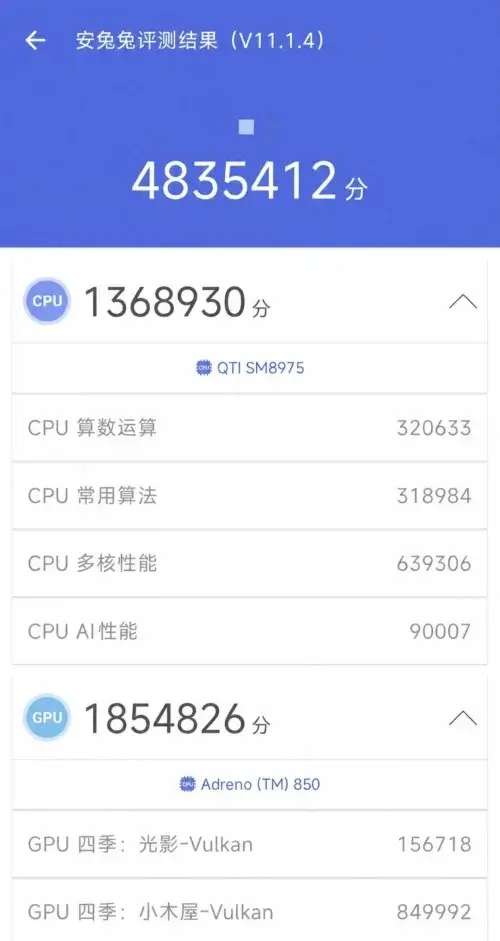
AnTuTu V11 benchmark result showing a total score exceeding 4.8 million points for a Qualcomm Snapdragon processor.
The Score and Its Limits
On August 14, 2026, DCS posted an AnTuTu V11.1.4 screenshot attributed to an SM8975 device:
Total score: 4,835,412
CPU subscore: 1,368,930
GPU subscore (Adreno 850): 1,854,826
Wccftech, Beebom, Gizmochina, and GSMArena have widely reported this. However, GSMArena noted that AnTuTu reportedly could not retrieve the result through its own backend verification system at the time of publication. Treat it as an early directional signal, not a confirmed performance figure.
Comparison Table
SD 8 Elite Gen 6 ProSD 8 Elite Gen 5 (Beebom)SD 8 Elite Gen 5 (REDMAGIC 11 Pro)
AnTuTu version V11.1.4 (leaked) V11 (independent run) V11 (leaderboard)
Total score 4,835,412 3,740,686 4,005,248
CPU subscore 1,368,930 1,054,518 Not published
GPU subscore 1,854,826 1,368,986 Not published
Hardware state Pre-production (assumed) Retail unit Retail unit, active cooling
Wccftech reports a 20.7% uplift relative to the REDMAGIC 11 Pro; Beebom reports roughly 29% relative to its own Gen 5 run. That variance illustrates exactly why a single headline percentage is unreliable here: the Gen 6 Pro result is from pre-production hardware at unknown firmware and thermal state, while Gen 5 reference scores come from retail devices under different conditions.
The benchmark vs. real-world distinction matters. A score recorded on pre-production hardware under benchmark conditions reflects peak performance. It says nothing about real-world performance- how the chip behaves after 15 minutes of gaming in a warm environment, inside a case, with software power limits engaged.
No independent thermal throttling data for the Gen 6 Pro exists. The N2P node may reduce heat generation at equivalent clock speeds. Still, the Gen 6 Pro’s reported higher frequencies and larger die area push in the opposite direction. The net thermal outcome depends on OEM-specific vapor chamber design and power management tuning variables that vary by device and are not available for any shipping product yet.
What Remains Unconfirmed
Qualcomm has not announced the Snapdragon 8 Elite Gen 6 Pro or published any official specifications.
“SM8975” and “Pro” branding are inferences from leaker-reported internal designations, not official product names.
Qualcomm has not confirmed the Adreno 850, Matrix ALUs, and AI Frame Fusion.
The AnTuTu screenshot has not been independently verified; AnTuTu reportedly could not retrieve the result through its backend.
Storage, modem, and connectivity specs each come from a single source.
No thermal throttling data from production hardware exists.
Snapdragon 8 Elite Gen 6 Pro: Frequently Asked Questions (FAQs)
When will the Snapdragon 8 Elite Gen 6 Pro be officially announced?
Qualcomm has not confirmed an announcement date. Multiple outlets, including VideoCardz and Beebom, cite Snapdragon Summit 2026, scheduled for September 22–24 in Mauias, as the expected reveal window.
Which phones are rumored to use it?
No OEM has officially confirmed an SM8975 device. GSMArena (August 14, 2026) reports the Xiaomi 18 Pro and Pro Max are expected to be among the first launches. Gizmochina (August 14, 2026) additionally names the iQOO 16 and OnePlus 16, with expected availability in late September or early October. The Honor Magic 9 Pro is separately reported to use a Gen 6-series chip, with a confirmed September 28 China launch date, though Honor has not specified which variant. All device associations are rumor-based.
How does the Pro differ from the standard Gen 6?
Based on current leaks, the primary differences are GPU-level: the Pro reportedly gets the Adreno 850 with 18MB GMEM, two Matrix ALUs, and AI Frame Fusion. The standard Gen 6 reportedly uses an Adreno 845 with 12MB GMEM and no Matrix ALUs. The CPU configuration and process node appear shared across both variants.
Are the leaked AnTuTu scores reliable?
Not yet. The 4,835,412 score from DCS (August 14, 2026) has not been independently replicated, and AnTuTu reportedly could not verify it through its backend. Pre-production hardware results also typically differ from retail performance. Treat it as a directional signal until independent reviews of shipping devices are available.
Author Bio
Abhijeet Shrivastava is a content writer at WriNews, where he covers smartphones, computers, laptops, electrical appliances, and a wide range of electronic and electrical components. With an academic background in Computer Science and additional knowledge and hands-on training in electrical systems and components, he brings both technical understanding and practical experience to his writing.
Alongside his work in content creation, Abhijeet serves as an assistant teacher at a school in Pune, combining his interest in technology with a passion for learning and education. He also runs his own workshop, where he regularly experiments with, repairs, and tinkers with electronic and electrical components. This hands-on experience helps him approach technology topics from both a practical and technical perspective.
Through his work, Abhijeet aims to make complex technology easier to understand while providing useful, accurate, and practical information for readers.