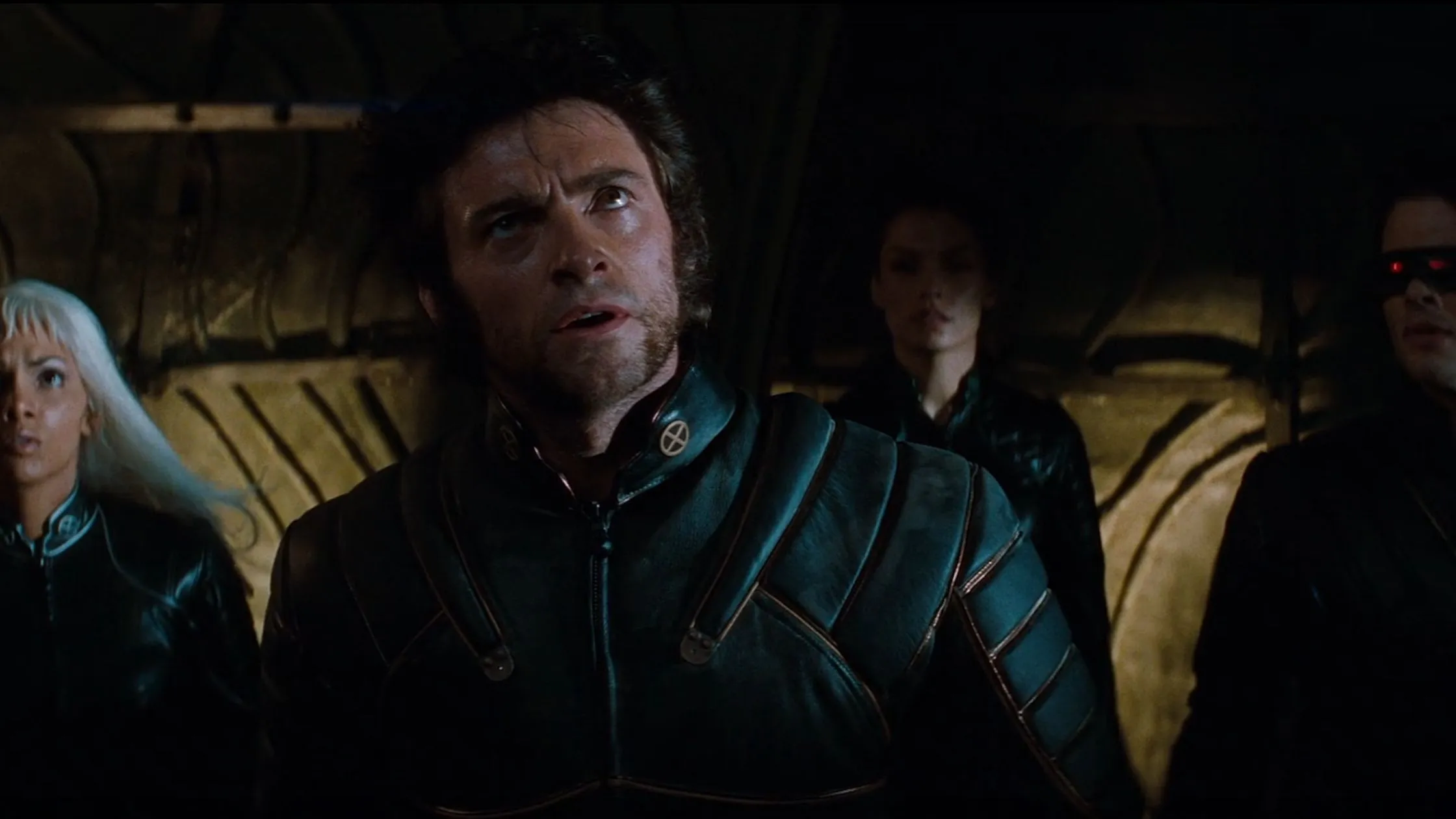
X2: X-Men United (2003) is one of the strongest superhero sequels of the pre-MCU era. Bryan Singer directs action with a confidence absent from the 2000 original, Brian Cox’s William Stryker gives the film a grounded, non-powered villain whose cold bureaucratic menace briefly makes Magneto sympathetic, and the mutant-as-minority allegory lands more precisely than in its predecessor. The main drag: Halle Berry’s Storm remains a flat presence, James Marsden’s Cyclops is sidelined almost entirely, and the third act buckles under too many simultaneous storylines.
That opening still lands. Nightcrawler breaches the White House in a sequence built around disorientation, teleporting in bursts of blue smoke, closing the distance on Secret Service agents before they can get a clear shot, moving so fast that John Ottman’s editing keeps you perpetually half a step behind. Alan Cumming’s mutant is a religious pacifist being controlled against his will. That detail does real work: one of the film’s central ideas that the wrong hands can weaponize even the most peaceful person in the room is laid out before a single character speaks an expository line. You never quite catch him. That’s deliberate.
Singer reportedly drew on The Empire Strikes Back as a creative reference point during production darker in tone, more character-driven, ending on an unresolved beat and that ambition shows in how the film is structured. Where the 2000 original hedged its bets, staging fights at arm’s length and rarely committing to its own weirdness, X2 is direct about what it wants to be.
Empire’s William Thomas, reviewing the film on release, wrote that Singer “no longer has any hang-ups about handling action,” and that shows in the technical scaffolding: cinematographer Newton Thomas Sigel gives the film a cool, steely look that feels distinct from the warmer, more primary-colored superhero films of the same era, and Ottman’s editing gives the action sequences urgency without sacrificing geography.
Why X2’s Wolverine Mansion Attack Is the Film’s Best Action Scene
The night-time assault on the X-Mansion, with Stryker’s soldiers storming the halls while children flee, is where Jackman’s Wolverine becomes something the first film only gestured at. He moves low and fast through corridors, dispatching soldiers with a brutality the original never allowed, and what makes it work isn’t the claws but the body language. He’s hunched, reactive, economical. There’s no heroic posturing. The sequence trusts you to feel the horror of what he’s capable of alongside the relief that he’s on your side.
The restraint in Jackman’s quieter scenes pays off here. The way he watches Stryker, jaw set, eyes tracking, reads as recognition rather than anger. That subtext gives the violence weight that pure action choreography can’t generate on its own.
Why X2’s Stryker Makes Magneto More Sympathetic
Brian Cox’s Colonel Stryker is a bureaucrat with a grievance. He speaks quietly, believes completely that he’s doing the right thing, and at no point tips into mustache-twirling. What makes him effective, and what shifts the film’s moral geometry, is that his stated goal isn’t chaos or dominion. He wants to eliminate a category of people he has decided shouldn’t exist, and he pursues that goal with the patient, procedural logic of a man who has already convinced himself it’s justified. Placed next to that, McKellen’s Magneto starts reading as someone whose paranoia at least has a traceable origin. The film doesn’t endorse him; it just gives you enough to understand how his worldview formed.
McKellen plays that carefully. There’s a moment aboard the X-Jet where he sits back, entirely at ease among people who distrust him, visibly running the angles, finding the situation more amusing than threatening. Rebecca Romijn’s Mystique earns her expanded role through physical specificity: she picks locks using her morphed body, seduces a prison guard while cycling through faces to identify which one he responds to, and shares scenes with McKellen where the two of them clearly enjoy each other’s company. Those details push her past the visual gimmick the first film was content to leave her as.
Famke Janssen, Patrick Stewart, and the Case for Underplaying
Famke Janssen’s Jean Grey is the film’s most understated performance, and that understatement is the point. Jean’s powers are escalating out of her control, and Janssen conveys that not through physical display but through a persistent stillness, the sense of something large being held in check by concentration alone. When that concentration slips, it registers.
Patrick Stewart’s Xavier operates at a similar register: measured, controlled, quiet in a way that reads as discipline rather than passivity. His scenes with McKellen have the texture of an old argument neither man expects to resolve. The disagreement between Xavier and Magneto isn’t really about policy. McKellen plays it that way, finding contempt and affection in the same line reading, and Stewart matches him.
Alan Cumming’s Nightcrawler is a different kind of problem to solve. He’s working under heavy prosthetics, largely limited to his eyes and voice, and he still projects more interiority than several cast members with full faces. He prays, hesitates, and flinches in ways that feel physiologically specific rather than performed, which is why the film’s more explicitly allegorical moments don’t tip into preachiness.
The Allegory That Hits, and the One That Doesn’t
The Iceman “coming out” scene is X2’s most discussed piece of allegory, and it earns that attention. Bobby Drake brings his on-the-run friends home to his suburban parents. When his mutation surfaces, his mother’s response, “Have you tried not being a mutant?” works because she isn’t playing a villain. She’s frightened and confused. The hurt lands not because the metaphor is clever but because the scene functions first as a believable family confrontation; the allegory sits inside that rather than sitting on top of it.
The Storm and Nightcrawler exchange about faith versus anger doesn’t manage the same thing. It gestures at the same territory the relationship between spiritual belief and political rage among persecuted people and then retreats into the kind of dialogue that sounds meaningful but resolves nothing. Slant’s Jeremiah Kipp, reviewing the film on release, identified it as one of the film’s shallower stretches, and that’s fair. The mutant-as-minority parallel runs through the whole film. Still, the screenplay occasionally settles for naming the theme rather than dramatizing it.
Where X2 Falls Short
Halle Berry’s Storm is the film’s most persistent weakness. She’s given almost nothing meaningful to do, two action set-pieces, and dialogue that frequently feels disconnected from the scene around it, flatter than the ensemble register the other performances establish. Whether that’s a direction problem, a writing problem, or something in the performance itself is hard to determine from what’s on screen. Still, the cumulative effect is the same: Storm never quite registers as a presence. Cyclops is a different problem: the screenplay sidelines James Marsden almost immediately and never recovers him.
Mild spoilers for the final act follow.
The third act is where the film starts to come apart at the seams. Singer is running four concurrent storylines: Stryker’s endgame, Magneto’s counter-scheme, Jean’s escalating arc, and a ticking-clock rescue, and they don’t converge so much as pile up. Empire’s William Thomas noted on release that “the third act sags a little under the sheer weight of storylines.”
Roger Ebert, reviewing the film for the Chicago Sun-Times and awarding it three stars, wrote that it “lacks a beginning, a middle and an end” and “lives in the present, providing one amazing spectacle after another.” Ebert was too dismissive of the film’s emotional throughline. Still, he was identifying something real: X2’s architecture is looser than its best scenes suggest. The pleasures here are concentrated in specific performances and sequences rather than in the overall structure.
What holds it together where the story strains is Ottman’s work: his score and editing function as the film’s structural backbone, and the first two hours feel taut largely because of how he paces them. When the editing stops being able to compensate for the screenplay’s third-act overload, you feel it.
What X2 gets right and what much of the franchise output that followed struggled to match is keeping the stakes personal before making them global. Stryker isn’t trying to destroy the world. He’s trying to eliminate a category of people he’s decided don’t belong in it.
Singer keeps that motivation human-scaled even when the action turns operatic, and the screenplay mostly resists the temptation to inflate it into something more abstract. The film doesn’t dramatize that consistently; Storm remains flat, the finale still buckles, but a superhero film that locates its tension in persecution rather than apocalypse is doing something the genre doesn’t attempt often enough. X2 does it well enough, often enough, that the film still has something to say.
Rating: 7.3/10
Also Read: X-Men (2000) Review
X2: X-Men United Cast, Crew & Other Info
Genre: Action, Sci-Fi, Thriller
Watch Here: X2
X2: X-Men United Frequently Asked Questions (FAQs)
Is X2: X-Men United better than the first X-Men film?
X2 is a substantial improvement over the 2000 original in three specific areas: action direction, villain construction, and ensemble writing. Singer stages fights with a confidence the first film rarely achieves, Cox’s Stryker gives the narrative a grounded antagonist where the original leaned on Magneto’s theatrics alone, and the screenplay actually uses characters like Mystique and Nightcrawler rather than leaving them as background furniture. The first film established the world; X2 is where Singer figured out what to do inside it.
Do I need to watch the first X-Men movie before X2?
It helps but isn’t essential. X2 reintroduces the core characters and their relationships early on. That said, the emotional payoffs, particularly around Professor X and Magneto, hit harder if you’ve seen the 2000 film first.
What is X2 an allegory for?
X2 uses mutants as a stand-in for marginalized groups, drawing on themes of persecution, civil rights, and identity. Its most discussed moment is the “coming out” scene, in which Iceman reveals his mutation to his parents, a sequence widely read as a metaphor for coming out as LGBTQ+. The film invites that reading deliberately: the scene’s structure, the parents’ discomfort, and the mother’s line asking whether Bobby has “tried not being a mutant” all map closely enough onto real coming-out dynamics that the parallel is difficult to dismiss as accidental.
Why is Nightcrawler’s opening scene so well regarded?
The White House sequence is celebrated for its editing and staging. Nightcrawler moves faster than the camera can hold, and Ottman’s fast-cut editing sustains the disorientation throughout. It’s also doing narrative work beyond spectacle, establishing the film’s central theme about how the powerless can be weaponized, which is why it continues to hold up.
Is X2: X-Men United still worth watching?
Yes. The Nightcrawler opening, the mansion attack, and Cox’s Stryker are as effective now as they were in 2003, and the Iceman scene remains one of the sharpest uses of mutant allegory in the franchise. Storm’s flatness and the overstuffed finale are genuine weaknesses, but they don’t sink it. For anyone interested in how superhero cinema developed before the MCU standardized the genre, X2 is essential.

Shikhar Jauhari is an entrepreneur, journalist, and digital content strategist with expertise in SEO, WordPress, and online publishing. He is the founder and editor of WRI News, where he covers entertainment, finance, government schemes & lifestyle. With a strong focus on delivering accurate, engaging, and reader-first content, he combines editorial excellence with data-driven SEO strategies to create content.
Over the years, Shikhar has worked as a content writer, editor, website manager, SEO specialist, business analyst, and finance professional for media platforms, businesses, and digital agencies. His experience spans content management, business strategy, taxation, accounting, and digital marketing, enabling him to approach every project with both editorial insight and strategic thinking.