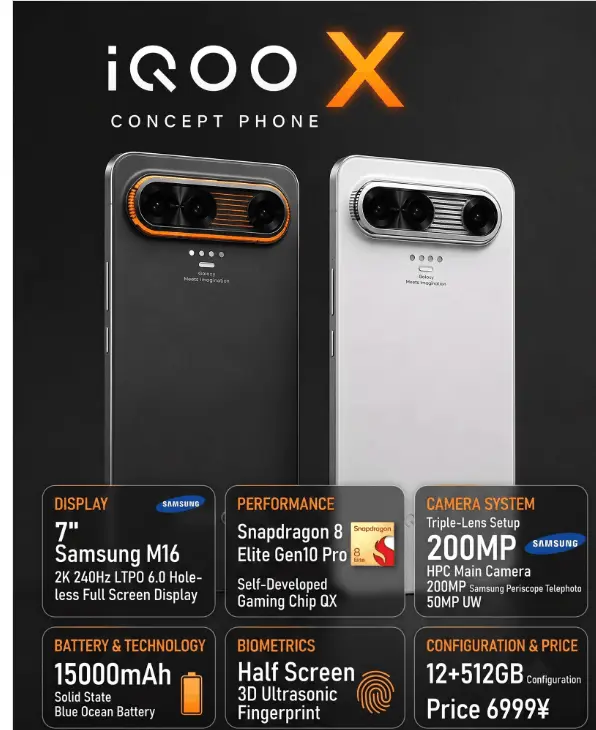
The iQOO X is a concept phone reportedly developed by iQOO to mark its 10th Anniversary as a Vivo sub-brand. According to information attributed to an internal showcase, it features a 15,000mAh all-solid-state “Blue Ice Battery,” a Snapdragon 8 Elite Gen 10 Pro chipset, a 7-inch 240Hz display, and a triple-camera system headlined by a 200MP Sony sensor. iQOO has not confirmed a commercial launch date or production commitment.
The iQOO X is a concept phone with reported specifications that push well beyond anything currently in production. That gap between ambition and engineering reality is what this analysis examines.
According to reports attributed to the internal event, the iQOO X was reportedly showcased alongside physical prototypes as part of iQOO’s 10th anniversary plans. Its reported specifications include a 15,000mAh battery in an era where 6,000mAh is considered generous, a chipset five generations beyond what Qualcomm currently ships, and a 200MP periscope telephoto camera that doesn’t yet exist in any mass-market device.
This analysis evaluates whether those reported specifications are technically feasible at smartphone scale.
Throughout this analysis, reported showcase information is distinguished from independently verifiable context, technical analysis, and future projections. Where a specification falls into each category is noted where it matters most.
The sections below cover what was reported, what the engineering data actually supports, and where the two diverge.
Vertical camera layout, subtle edge ridges, thin bezels, under-display selfie camera
Reported Pricing
¥6,999–¥8,599 (~$1,038–$1,275) depending on configuration
What Is the iQOO X?
The iQOO X is a concept phone reportedly developed by iQOO, a sub-brand of Vivo launched in 2019. Because iQOO was founded in 2019, its 10th Anniversary falls in 2029, making that a plausible reference point for the device’s long-term roadmap. However, iQOO has not announced a launch tied to that date, and the iQOO X should be understood as a forward-looking showcase rather than a near-term commercial product.
Reports attributed to the internal showcase suggest the device was developed with direct input from iQOO’s fan community. This notable development strategy blends aspirational design with consumer-informed feature prioritization. Physical prototypes were also reportedly presented at the event, lending the concept a degree of material seriousness beyond a standard rendered slideshow.
No commercial launch date has been announced. Pricing variants ranging from ¥6,999 to ¥8,599 depending on RAM and storage configuration were reported at the showcase. Still, these figures appear to function as competitive positioning signals for the concept rather than confirmed retail prices.
Full Specifications Breakdown of iQOO X
Display: Samsung M16 LTPO 6.0, 2K+, 240Hz
Based on information attributed to the internal showcase; independently unverified.
The Samsung M16 panel is a notable claim in the reported specifications. For context, the Samsung M14 is the most recently referenced production panel in publicly available flagship device coverage cited in connection with the Galaxy S26 Ultra and the iQOO 15. If that generational naming holds, the M16 would represent two full panel generations beyond current publicly documented hardware, making it a projected future component rather than anything iQOO could source today. That said, Samsung Display’s internal panel roadmap is not public, so the M16 designation in this context should be treated as reported showcase information rather than a confirmed future product.
The 4,800Hz touch sampling rate is also extraordinary by current standards, where 360Hz is considered high-end. Achieving this at scale would require substantial firmware and hardware co-development.
Chipset: Snapdragon 8 Elite Gen 10 Pro + iQOO QX E-Sports Chip
Chipset name and co-processor are drawn from showcase reports; performance estimates below are the author’s own analysis.
Based on publicly available coverage ahead of the Snapdragon Summit, Qualcomm’s current flagship is reported to be the Snapdragon 8 Elite Gen 5, clocked at up to 4.6GHz and paired with the Adreno 840 GPU. The Snapdragon 8 Elite Gen 6 Pro is widely anticipated as the next release, expected to be announced at Qualcomm Summit in September 2026.
The Snapdragon 8 Elite Gen 10 Pro is, by that sequence, approximately five chipset generations beyond today’s hardware. Performance projections at that generational distance are speculative. Still, if historical improvement curves hold (roughly 20–30% IPC gains per generation), the Gen 10 Pro could represent a substantial leap in both compute and energy efficiency over current silicon.
One source has flagged the Snapdragon 8 Elite Gen 6 Pro as an alternative chipset consideration for a nearer-term variant. This remains unconfirmed by iQOO.
[Internal Link: Snapdragon 8 Elite Gen 5 vs. Gen 6 Pro: What to Expect]
Camera System: Triple 200MP Configuration (Reported)
Based on information attributed to the internal showcase; independently unverified.
Primary: 200MP Sony HPC OIS, 1/1.3-inch sensor
Telephoto: 200MP Samsung periscope
Ultrawide: 50MP Samsung
For reference, the iQOO 15’s main camera is reported to use a 50MP 1/1.56-inch sensor, based on publicly available specifications. The iQOO X primary sensor, as reported at the showcase, would be both higher in resolution and physically larger, with a 1/1.3-inch format that, in principle, offers greater light-gathering area per pixel at equivalent settings. Whether that translates to meaningfully better low-light output in practice depends on additional factors including pixel binning implementation, lens aperture, and image processing pipeline, none of which have been detailed for the iQOO X.
A reported 200MP periscope telephoto would be unusually aggressive by current flagship standards. Periscope telephoto sensors in shipping flagship devices typically reach 50MP; a 200MP configuration at the same focal length would require meaningful advances in sensor design, optical element miniaturization, and module packaging to maintain image quality without increasing the periscope assembly’s physical footprint.
Of all the reported specifications, the 15,000mAh solid-state battery is the most consequential claim both technically and commercially. No charging speed was detailed in any of the cited reports covering the showcase.
RAM & Storage Variants in iQOO X
Based on information attributed to the internal showcase; not independently verified by a third party.
Drawn from concept materials and physical prototypes shown at the internal showcase; independent verification is unavailable.
Vertical camera layout with subtle edge ridges
Under-display selfie camera
Thin bezels
Available in Black and White colorways
Technical Analysis: 15,000mAh Battery Engineering Implications of iQOO X
Device Dimensions & Weight Distribution Challenges
Fitting a 15,000mAh battery into a conventional smartphone chassis would be extremely challenging at current energy densities. Current lithium-ion cells used in flagship smartphones deliver approximately 700–800Wh/L of volumetric energy density. A 15,000mAh cell at 3.7V nominal voltage represents roughly 55.5Wh of energy comparable to, or exceeding, some ultrabook laptop batteries. Accommodating that capacity in a phone-sized chassis without a significant increase in device thickness would likely require solid-state chemistry to approach its theoretical ceiling of 1,000Wh/L or higher volumetric density, a threshold that has not yet been achieved in commercial smartphone production.
Weight is the second constraint. Smartphone batteries currently contribute roughly 40–50g per 5,000mAh of capacity. Scaling linearly (before solid-state efficiency gains), a 15,000mAh cell could add 120–150g to total device weight. Even with solid-state improvements, a 200–250g total device weight would represent a challenging ergonomic trade-off for a 7-inch device.
Solid-State Battery Technology vs. Current Li-ion mAh Density
All-solid-state batteries substitute liquid electrolytes with solid ceramic or polymer alternatives. The core advantages are higher theoretical volumetric energy density, reduced risk of electrolyte leakage, and greater electrochemical stability across temperature ranges, all of which matter for a high-capacity cell in a tightly packed chassis. Commercial solid-state cells exist today in small consumer electronics, but mass-market smartphone production at 15,000mAh scale remains well beyond current manufacturing capabilities. Industry investment from companies such as Toyota, Samsung SDI, and CATL indicates the technology is advancing, though that investment does not by itself confirm the timeline or capacity targets required for a device like the iQOO X. Whether solid-state production reaches smartphone-relevant scale by 2029 is plausible as a target but unconfirmed.
Thermal Management & Cooling Requirements for High-Density Batteries
Thermal behavior in high-capacity cells is determined by a combination of factors: internal resistance, charging current, cell chemistry, conversion efficiency, and the thermal management system, rather than energy density alone. A solid-state cell at 15,000mAh could, in principle, exhibit lower heat generation than a lithium-ion equivalent if its internal resistance and electrochemical losses are reduced. Still, that outcome depends heavily on manufacturing quality and operating conditions that have not been detailed for the iQOO X. The “Blue Ice Battery” branding suggests iQOO has conceptualized a dedicated thermal management approach for the cell. Still, no specific architecture details such as cooling materials, heat spreader design, or phase-change integration were documented in any of the reports covering the internal showcase.
Charging Speed Considerations of iQOO X
No charging speed has been confirmed for the iQOO X in any of the cited reports covering the internal showcase. If iQOO were to pursue fast charging at the level it currently offers 120W on 5,000–6,000mAh cells, scaling that to a 15,000mAh solid-state cell without thermal runaway risk would likely require significant advances in cell chemistry, a multi-cell parallel charging architecture, or both. Neither approach is technically implausible by 2029, but no details have been confirmed, and any charging specification for the iQOO X should be treated as unannounced until iQOO issues a public statement.
[Internal Link: How All-Solid-State Batteries Work and Why They Matter for Smartphones]
Technical Analysis: Snapdragon 8 Elite Gen 10 Pro Architecture
SoC Generational Gap (Current Gen 5 vs. Projected Gen 10 Pro)
Based on publicly reported Snapdragon naming cadence, the Snapdragon 8 Elite Gen 5 is Qualcomm’s current flagship SoC, operating at up to 4.6GHz with the Adreno 840 GPU. The Gen 6 Pro is widely anticipated at Qualcomm Summit in September 2026. If Qualcomm continues its roughly annual release cadence, a Gen 10 Pro platform would not be expected until approximately 2030, placing it a full generation beyond iQOO’s own 10th anniversary reference point of 2029. That gap makes the iQOO X’s chipset choice a marker of long-range ambition rather than a specification tied to any near-term product roadmap.
This either suggests iQOO’s timeline anticipates a product launch nearer 2030, or that the Gen 10 Pro designation in the showcase is aspirational naming rather than a locked hardware commitment.
Five chipset generations of development, assuming continued scaling to sub-3nm process nodes and sustained architectural improvements per generation, could plausibly deliver 50–80% gains in multi-core CPU throughput and comparable GPU raster performance improvements over the Gen 5. These figures are generational extrapolations based on historical IPC improvement rates and process node scaling trends, not on Qualcomm benchmarks or official architecture disclosures. NPU performance for on-device AI inference could scale more dramatically still, given the current trajectory of AI accelerator investment at Qualcomm and its primary fabrication partner, TSMC; though, again, no Gen 10 Pro architectural details have been published by either company.
All figures above are projections, not manufacturer claims.
More powerful SoCs generate more heat, and the pairing of a high-performance chipset with an iQOO QX e-sports co-processor adds another thermal load to an already heat-sensitive chassis. iQOO’s inclusion of a dedicated e-sports chip suggests awareness of sustained-load scenarios, such as gaming sessions, where thermal throttling degrades frame rates. Effective co-processor offloading (routing specific workloads to the QX chip) could extend sustained performance headroom. Still, the physical thermal dissipation architecture must be designed around the combined TDP of both chips.
Feasibility & Engineering Trade-offs of Concept Phones
Confirmed Manufacturer Data vs. Speculative Features
The core hardware list display panel type, chipset name, battery capacity, camera sensor partnerships, RAM/storage configurations, and pricing originates from sources covering the internal event rather than from a public iQOO statement. Where a specification goes beyond what is reported (such as performance projections or component availability estimates), it is identified as analysis or projection in the relevant section.
Four specifications fall outside current commercial production capabilities: the Samsung M16 panel (two generations beyond the current M14, with no public Samsung Display roadmap confirmation); a 15,000mAh solid-state cell at smartphone scale (no commercial manufacturer has announced this capacity in an all-solid-state format); the Snapdragon 8 Elite Gen 10 Pro’s performance architecture (Qualcomm has not disclosed any roadmap beyond the Gen 6 Pro); and a 200MP Samsung periscope telephoto (no such sensor has been announced or documented in production). All four should be treated as projected or speculative targets, not sourced components.
Panel Availability: Samsung M16 vs. Current M14
Based on publicly referenced flagship panel generations, the Samsung M14 is the most recently documented production standard cited in connection with the Galaxy S26 Ultra and the iQOO 15. The reported M16 designation in the iQOO X showcase materials implies a future display-generation target, approximately two panel generations ahead of the most recently public reference point, rather than a component iQOO has secured or that Samsung Display has announced. Any commercialization of the iQOO X with an M16-class panel would depend entirely on Samsung Display’s internal development roadmap aligning with iQOO’s launch window. This dependency cannot be confirmed from available public information.
Weight, Ergonomics & Cooling Architecture
A 7-inch display, 15,000mAh battery, and dual-chip architecture present significant weight and thermal management challenges that any commercial version of the iQOO X would need to resolve. A device combining these elements would carry substantial internal mass, and maintaining an ergonomic profile without increasing thickness considerably would require careful compromise between battery cell geometry, thermal spreader placement, and chassis material selection. The vertical camera layout shown in reported design renders may indicate a preference for concentrating mass along one axis. Still, no internal packaging details have been documented for the concept, meaning the actual weight distribution strategy remains an open engineering question rather than something that can be inferred from exterior design alone.
Comparison Table iQOO X vs. Current Flagship Benchmarks
iQOO 15 and Galaxy S26 Ultra data are based on publicly available specifications. iQOO X data is based on reported concept-showcase information, not independently confirmed by iQOO.
iQOO as a Vivo Sub-brand (Founded 2019, 10th Anniversary ~2029)
iQOO was founded as a Vivo sub-brand in 2019, with an initial focus on performance and gaming smartphones in China. The brand has since expanded internationally and is positioned around high-specification hardware at competitive prices. Because iQOO was founded in 2019, its 10th Anniversary falls in 2029, a date that reporters and analysts have used as a reference point for contextualizing the iQOO X concept. However, iQOO has not publicly tied the device to a specific anniversary launch plan.
Pricing Revealed for a Concept Device (¥6,999–¥8,599)
Concept phones rarely come with price tags; there’s no product to sell. The fact that iQOO attached pricing to the iQOO X most likely signals where the brand intends to compete in the premium segment once these specifications become achievable, rather than indicating a firm retail commitment.
If the reported ¥8,599 top configuration were ever applied commercially, it would place the iQOO X in premium-flagship territory broadly comparable to top-tier global flagships such as Samsung’s Galaxy S Ultra lineup.
R&D Showcase vs. Commercial Intent
Based on reported concept materials, the iQOO X appears to function primarily as an R&D showcase, a proof-of-concept intended to signal technical ambition and, reportedly, to validate potential supplier partnerships with Sony and Samsung. According to sources covering the internal event, fan input also shaped the concept’s reported feature set. However, the degree to which that input influenced specific specifications has not been independently documented.
IQOO has announced no commercial launch. Because the concept is associated with iQOO’s 10th Anniversary, 2029 is a plausible reference point for the device’s timeline. Still, iQOO has not confirmed a launch date or production commitment tied to that milestone. Whether iQOO moves toward commercialization at all will depend on how quickly solid-state battery production scales and how Qualcomm’s chipset roadmap evolves.
Verdict: Technology Concept, Not a Confirmed Smartphone
The iQOO X is more deliberate than a typical concept drop. Physical prototypes, configuration-level pricing, and reported component partnerships with Sony and Samsung all suggest this is an active R&D exercise with commercial intent somewhere on the horizon, not a rendered thought experiment.
The gap between reported specifications and available components is real, but it is not the most useful frame for evaluating this device. The more relevant question is whether iQOO’s engineering bets on solid-state energy density, on advanced display generations, on next-decade silicon are being placed early enough to matter. Based on current technology trajectories, most are plausible by 2029. None are guaranteed.
By making these bets early on solid-state energy density, next-decade silicon, and supplier partnerships with Sony and Samsung, iQOO is staking out a competitive position that is difficult for rivals to quickly replicate. If even a portion of these technologies mature on schedule, iQOO enters its second decade with R&D infrastructure and supplier relationships already in place, rather than scrambling to adopt them after competitors do.
The iQOO X is not a product announcement; it is a strategic signal. It shows where iQOO is committing its R&D resources and which supplier relationships it is building for the decade ahead. Whether any of it reaches retail depends on manufacturing timelines that no one can guarantee today. But brands that wait until a technology is proven before investing rarely define the category. iQOO is betting it won’t have to wait.
iQOO X Frequently Asked Questions (FAQ’s)
Is the iQOO X going to be released commercially?
IQOO has confirmed no commercial release. The iQOO X was presented at an internal anniversary showcase reportedly with physical prototypes, but no launch date, market availability, or production commitment has been announced. Because the concept is associated with iQOO’s 10th Anniversary, 2029 is a plausible reference point for the device’s timeline. Still, iQOO has not confirmed a launch date or production commitment tied to that milestone.
What makes the 15,000mAh solid-state “Blue Ice Battery” different from current smartphone batteries?
Current flagship smartphones use lithium-ion cells with volumetric energy densities of approximately 700–800Wh/L. All-solid-state batteries replace the liquid electrolyte with a solid ceramic or polymer alternative, which removes a key source of electrochemical instability and theoretically enables volumetric energy densities of 1,000Wh/L or higher, allowing significantly more capacity within the same physical volume. At 15,000mAh and a nominal voltage of 3.7V, the iQOO X cell would store roughly 55.5Wh of energy, comparable to or exceeding many laptop batteries. The “Blue Ice Battery” branding may suggest a dedicated thermal management approach, but no cooling architecture details were documented in any of the reports covering the internal showcase. How iQOO intends to manage heat under charge and discharge at that capacity remains unconfirmed.
How many generations away is the Snapdragon 8 Elite Gen 10 Pro from today’s chipsets?How many generations away is the Snapdragon 8 Elite Gen 10 Pro from today’s chipsets?
Based on publicly documented Snapdragon naming and Qualcomm’s annual release cadence, the Gen 6 Pro is widely anticipated at Qualcomm Summit in September 2026, making the Gen 10 Pro approximately four to five chipset generations beyond the next publicly expected platform. By linear projection, that would place a Gen 10 Pro-class chip around 2030 or later, well outside any confirmed Qualcomm roadmap disclosure. The iQOO X’s chipset designation is best understood as a forward-looking concept reference, a placeholder for whatever flagship-tier silicon Qualcomm ships closest to iQOO’s 10th anniversary window, rather than a near-term commercial chipset expectation. One source (Sportskeeda/@Gadgetsdata) has noted the Snapdragon 8 Elite Gen 6 Pro as an alternative chipset consideration for a shorter-term variant of the concept, though this remains unconfirmed by iQOO.
What is AI dynamic partition refresh rate on the iQOO X display?
AI dynamic partition refresh is a display technology that applies variable refresh rates to different regions of the screen simultaneously, rather than applying a single global refresh rate to the entire panel. The iQOO X’s reported specification names this feature, but no detailed implementation description was documented in any of the reports covering the internal showcase. Based on how analogous technologies function in current LTPO displays, the likely intent is to allow static UI elements such as a status bar or background to refresh at a lower rate to conserve power, while fast-moving content like video or gameplay refreshes at the full 240Hz. This interpretation is the author’s analysis of the reported feature name, not a documented iQOO implementation detail. The practical outcome of such an approach, if implemented as described, would be improved battery efficiency without sacrificing visual smoothness in motion-heavy content.
*Source note: Specifications described in this article as “showcase information” are drawn from reports attributed to iQOO’s internal anniversary presentation, as covered by different media outlets. Unless otherwise noted, these specifications are reported from the internal showcase and have not been independently verified. Battery feasibility assessments use nominal voltage calculations and published volumetric energy density ranges for current lithium-ion and projected solid-state chemistries. Chipset performance projections are derived from historical generational improvement rates, not from Qualcomm benchmarks or roadmap disclosures. Component availability for the Samsung M16 panel, 15,000mAh solid-state cells, and 200MP periscope sensors is evaluated against current commercial manufacturing capabilities and publicly known production timelines.
Author Bio
Abhijeet Shrivastava is a content writer at WriNews, where he covers smartphones, computers, laptops, electrical appliances, and a wide range of electronic and electrical components. With an academic background in Computer Science and additional knowledge and hands-on training in electrical systems and components, he brings both technical understanding and practical experience to his writing.
Alongside his work in content creation, Abhijeet serves as an assistant teacher at a school in Pune, combining his interest in technology with a passion for learning and education. He also runs his own workshop, where he regularly experiments with, repairs, and tinkers with electronic and electrical components. This hands-on experience helps him approach technology topics from both a practical and technical perspective.
Through his work, Abhijeet aims to make complex technology easier to understand while providing useful, accurate, and practical information for readers.