The Beginning and the End Netflix One Piece Live Action Season 2 Episode 1: Review, Summary & Recap
Shikhar Jauhari
July 24, 2026
Netflix’s One Piece Season 2, Episode 1, “The Beginning and the End,” picks up the Straw Hats’ momentum with a compressed but confident Loguetown arc. This season premiere juggles four simultaneous threats: Baroque Works, Buggy and Alvida, Smoker, and Dragon, while delivering standout performances from Iñaki Godoy and Mackenyu. Even when the effects wobble, the storytelling stays steady.
Season 1 ended with a crew. Season 2 opens with consequences. That difference matters more than it might seem. Netflix’s live-action adaptation of Eiichiro Oda’s One Piece spent its first run proving that this was a streaming adaptation that understood the source material. “The Beginning and the End” no longer has that grace period. Expectations are already in place, and the episode has to move with purpose.
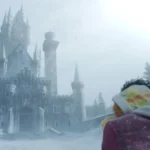
Loguetown looks lived in. Street vendors crowd narrow alleys, banners hang from weathered buildings, and every corner suggests a town preparing for celebration while expecting trouble. The execution platform at the center anchors everything. It communicates history before anyone says a word, and the episode uses that visual weight well.
Why One Piece Season 2, Episode 1 Works as a Season Premiere
Rather than building toward a single confrontation, this premiere stacks four threat lines across one location: Baroque Works operating in the shadows, Buggy and Alvida converging from below, Smoker hunting Luffy with real menace, and Dragon appearing at the edge of the story in a way that changes how the ending reads in retrospect. Compressing the Loguetown arc into a single episode demands this kind of discipline, and the writing mostly holds the line. Manga readers will notice where connective tissue has been trimmed, but the episode rarely loses control of its pacing.
Smoker is the premiere’s strongest new presence. His bar monologue, delivered with quiet conviction, reframes justice in a way the live-action adaptation has not really attempted before. He comes across as a man who has decided that law is the only honest thing left in the world. That belief makes him dangerous, and his Smoke-Smoke Fruit powers create a physical threat that Luffy’s rubber body cannot simply absorb. The CGI behind those powers is uneven. Wide shots sell the smoke better. Close-ups, where the effect needs texture and weight, reveal the production’s limits more clearly.
Miss All Sunday’s introduction moves on a different wavelength. Viewers who know the anime or manga will recognize her as Nico Robin, but the episode wisely does not rush to explain everything at once. Her Flower-Flower Fruit effects are more stylized than Smoker’s, and the contrast seems deliberate. Her screen time is brief; the attack on the Marine base is over quickly, but the way she moves through it, barely raising her voice, sets the tone for how the show may handle Baroque Works from here. Present enough to threaten. Reserved enough to provoke curiosity.
That restraint matters because Season 2 is not only setting up the next stop. It is also laying track for Whisky Peak and, beyond that, the larger Alabasta Arc. The episode does not overplay those connections, but the sense of a wider kingdom conspiracy, civil unrest, and royal conflict is starting to take shape in the background.
Iñaki Godoy and the Evolution of Luffy in Netflix One Piece Season 2
Godoy’s Luffy has grown. That is the clearest takeaway from this Netflix One Piece season premiere. Season 1’s version of the character was loose, instinctive, and driven by appetite and loyalty in roughly equal measure. Here, standing on the execution platform where Gold Roger once stood and laughed before his death, Godoy brings in something more layered: an understanding of what this moment means not only to Luffy, but to the entire era Roger set in motion. His laugh on the scaffold echoes Roger’s. The scene asks the audience to hold both moments at once, and Godoy gives that parallel real weight.
Gold Roger’s line to Garp, “Night may be falling on my time, but his dawn is only just beginning”, is the emotional hinge the whole episode turns on. It could have tipped into melodrama. Instead, the staging keeps it controlled. The platform, the crowd, the silence afterward. Some lines need space, and this one gets it.
Mackenyu’s Zoro gets the most satisfying individual character beat in the episode. The sword shop sequence, Zoro testing the cursed Sandai Kitetsu by tossing it into the air, arm extended, and letting fate decide, is staged with real confidence. Mackenyu plays it with controlled stillness. No speech. No flourish. Just a swordsman testing whether luck has any say over what comes next.
His later fight with Tashigi sharpens what the show consistently handles best with Zoro: physical storytelling. Swordplay translates to live action more naturally than Luffy’s rubber-bodied combat, and this premiere leans into that advantage. That choice works in the moment, but it also highlights a larger imbalance. When the cleanest action belongs to Zoro instead of Luffy, the difference stands out.
Where Netflix One Piece Season 2, Episode 1 Falls Short
Luffy’s Gum-Gum powers have been the live-action adaptation’s most persistent technical problem, and “The Beginning and the End” does not solve it. The elastic-body effects still sit in an awkward space between cartoon logic and live-action weight. They function, but they do not yet deliver the snap, force, or momentum that make the ability so exciting in the manga and anime. Routing the strongest action through Zoro is a practical workaround. But it comes with a tradeoff. Luffy is the protagonist, and when his clash with Smoker registers as the weakest action stretch in an otherwise strong episode, the gap is hard to miss.
Nami’s exchange with Bartolomeo lands somewhere between connective tissue and missed opportunity. Her pickpocketing advice plays more like exposition than a scene with its own spark, which becomes a minor issue in the episode’s busiest sections. With four storylines competing for time, some Straw Hats were always going to be pushed to the edge. Nami gets less room than she deserves here.
Elsewhere, Loguetown itself is handled with warmth and specificity. The festival-day crowd scenes have a tactile quality that makes the world look populated rather than staged. The shift from celebration to tension, as Smoker tightens the net, is paced with care. And Dragon’s appearance, kept deliberately understated, has impact whether you read it as a mystery for new viewers or as a major signpost for longtime fans.
The episode also does a smart job of suggesting what kind of season this may become. Season 1 often ran on adventure and crew chemistry. Episode 1 of Season 2 starts steering the story toward government crisis, monarchy under siege, and organized opposition working behind the scenes. Baroque Works is not just another villain group. It points toward a larger conflict, one that will likely involve figures like Mr. 5 and Miss Valentine before the Going Merry gets anywhere near the heart of Alabasta.
Why One Piece Season 2, Episode 1 Succeeds as a Season Premiere
A season premiere has one job: define what the new season is trying to do and make the audience want the next episode. “The Beginning and the End” handles both. The Loguetown compression works because the episode never loses sight of what this arc is really about: inheritance. Gold Roger’s shadow, Luffy’s ambition, Smoker’s rigid ideology, and Dragon’s intervention all circle the same question: what does it mean to enter a world shaped before you arrived?
When Luffy reaches the platform, looks out at the crowd, and lets the laughter come, the moment carries more than simple recognition for manga and anime fans. It is the show committing to its own mythology. It is Netflix’s adaptation saying it is ready to think bigger.
The ending, with the Straw Hats sailing toward Reverse Mountain as the Grand Line comes into view, is the right conclusion to that thematic movement. Not an arrival. A departure. That is exactly what the hour has been building toward.
The Beginning and the End – One Piece Live Action Season 2 Episode 1: Cast
Iñaki Godoy: Monkey D. Luffy
Emily Rudd: Nami
Mackenyu: Roronoa Zoro
Jacob Romero: Usopp
Taz Skylar: Sanji
Lera Abova: Miss All Sunday
Vincent Regan: Garp
Jeff Ward: Buggy
Ilia Isorelýs Paulino: Alvida
Callum Kerr: Smoker
Julia Rehwald: Tashigi
Camrus Johnson: Mr. 5
Jazzara Jaslyn: Miss Valentine
James Hiroyuki Liao: Ipponmatsu
Rigo Sanchez: Dragon
Michael Dorman: Gold Roger
Nahum Hughes: Bartolomeo
The Beginning and the End – One Piece Live Action Season 2 Episode 1: Crew
Director: Emma Sullivan
Writing Credits: Eiichirô Oda, Matt Owens, Ian Stokes, Steven Maeda, Alex Regnery
Producer: Taro Goto, Tom Hyndman, Takuma Naitô, Tatsumi Yoda
Executive Producer: Marty Adelstein, Becky Clements, Tetsu Fujimura, Steven Maeda, Eiichirô Oda, Matt Owens, Chris Symes, Joe Tracz
Co-Producer: Robert W. Egami, Lindsay Gelfand, Allison Weintraub
Associate Producer: Gabriel Henrique Gonzalez, Sonia Knape, Corry Turner
Co-Executive Producer: Elizabeth Hunter, Nic Louie, Ian Stokes, Emma Sullivan, Stephen Welke, Ashley Wigfield
Producer (South Africa): Marisa Sonemann-Turner, Rudi Van As
The Beginning and the End – One Piece Live Action Season 2 Episode 1: Other Info
Air Date: 10 March 2026
Run Time: 1h 6m
Distributor: Netflix
Production Co: Hurwitz Creative, ITV Studios, Kaji Productions
Special Effects: Framestore
One Piece Season 2, Episode 1 Frequently Asked Questions
Is One Piece Season 2, Episode 1 worth watching?
Yes, especially if you finished Season 1. “The Beginning and the End” is a confident, well-paced season premiere that compresses the Loguetown arc without losing its emotional center. Even with some CGI limitations and uneven screen-time distribution across the crew, the episode delivers strong performances, vivid production design, and a scaffold scene that stands among the live-action adaptation’s best moments so far.
Does Dragon fight in Episode 1?
No. Monkey D. Dragon appears only briefly, stepping in to halt Smoker’s pursuit of Luffy near the end of the episode. He stops Smoker with a few words and then disappears into the crowd. The moment is intentionally mysterious. The episode does not explain who he is or why he intervenes, but longtime fans will recognize how important that entrance is.
Why does Luffy laugh at the execution platform?
Luffy laughs in the face of what looks like certain death because this is where Gold Roger’s legend began, and laughing at the edge of the end is exactly what Roger did. It is not simple recklessness. It is conviction. Luffy knows who he is and what he is chasing, and no execution platform changes that. Smoker, watching from below, immediately recognizes the parallel.
What changed from the manga in this episode?
Several additions stand out. Dragon’s role at the end of the Loguetown arc is present in the manga, but the live-action version frames his appearance with more deliberate mystery. Bartolomeo, a major character much later in the story, appears here earlier than his canonical introduction. The flashback between Gold Roger and Garp is also given more emotional emphasis than it had at this stage in the source material.
Does One Piece Season 2, Episode 1 follow the manga storyline closely?
The episode adapts the Loguetown arc from Chapters 96–100 of the manga, but it compresses that material heavily to fit a single episode. Key beats remain intact: Luffy on the execution platform, Zoro acquiring the Sandai Kitetsu, Smoker’s introduction, Miss All Sunday’s appearance, and Dragon’s intervention. What changes most is the connective material between those moments.
Who is Smoker, and why does he matter in Season 2?
Smoker is a Marine captain stationed in Loguetown who ate the Smoke-Smoke Fruit, giving him the ability to become and control smoke. His powers directly counter Luffy’s rubber body, making him one of the first East Blue opponents who can genuinely corner Luffy in combat. Just as important, he represents a stricter and more principled version of justice than the show’s earlier villains, which makes him a more serious recurring threat.
What is the Sandai Kitetsu, and why is Zoro’s test significant?
The Sandai Kitetsu is a cursed sword said to bring misfortune to its owners. In the sword shop scene, Zoro tests it by throwing it into the air with his arm extended. If the curse is real, the blade should cut him. It does not. The scene works because it reveals character so cleanly. Zoro does not fear a bad omen. He is willing to carry the risk.
Is One Piece Season 2 suitable for viewers who haven’t seen Season 1?
It is technically followable, but that is not the ideal way to watch it. Season 2 assumes you already know the Straw Hats and their histories. New viewers can follow the broad plot, but the emotional payoff, especially Luffy’s moment on the scaffold, becomes much stronger with Season 1 behind it.
How does the live-action handle Luffy’s Devil Fruit powers?
This remains the adaptation’s clearest technical weakness. The rubber-body effects are workable, but they still lack the visual energy of the anime. Episode 1 does not fully solve that problem, though it compensates by giving more of the action emphasis to Zoro, whose combat style fits live-action more naturally.
What is Reverse Mountain, and what does it signal for Season 2?
Reverse Mountain is the only safe entrance into the Grand Line: an uphill river that carries ships into the world’s most dangerous sea. Ending the episode there signals a clear shift in scope. East Blue is behind them. What comes next is bigger, stranger, and far more dangerous.
Shikhar Jauhari is an entrepreneur, journalist, and digital content strategist with expertise in SEO, WordPress, and online publishing. He is the founder and editor of WRI News, where he covers entertainment, finance, government schemes & lifestyle. With a strong focus on delivering accurate, engaging, and reader-first content, he combines editorial excellence with data-driven SEO strategies to create content.
Over the years, Shikhar has worked as a content writer, editor, website manager, SEO specialist, business analyst, and finance professional for media platforms, businesses, and digital agencies. His experience spans content management, business strategy, taxation, accounting, and digital marketing, enabling him to approach every project with both editorial insight and strategic thinking.