Netflix Live Action One Piece Season 2 Review, Recap: Into the Grand Line
Shikhar Jauhari
August 10, 2026
Netflix’s One Piece Season 2 is a stronger adaptation than its predecessor in almost every meaningful way. The character work is more developed, the island settings feel genuinely distinct from one another, and several emotional sequences land harder than anything the first season attempted. The introduction of Chopper, Vivi, and Miss All Sunday gives the ensemble more to work with, while the Baroque Works conspiracy provides a through-line that the East Blue arc never quite had.
The main weakness remains the eight-episode format: covering five major arcs means some storylines resolve faster than they should, and a few emotional shifts feel rushed as a result. Fans of the manga and anime will find plenty to love; newcomers willing to commit to both seasons will find a show that finally knows what it wants to be.
Into the Grand Line: What Netflix One Piece Season 2 Is About
The eight-episode run follows the Straw Hat crew through the early Grand Line from Loguetown and the uphill nightmare of Reverse Mountain, through the bounty-hunter trap of Whisky Peak, the prehistoric oddity of Little Garden, and finally to the snowbound tragedy of Drum Island, where the crew recruits their new doctor. Running beneath all of it is the Baroque Works conspiracy, orchestrated by the still-largely-offscreen Crocodile and managed on the ground by the enigmatic Miss All Sunday.
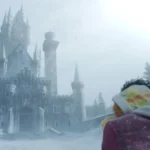
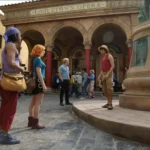
The island-hopping format suits the material. Each location has its own visual logic and emotional register. Whisky Peak looks like a Spaghetti Western fever dream, all warm lantern light and enormous cacti silhouetted against a night sky. Little Garden feels like a natural history diorama scaled up to terrifying size. Drum Island is cold, quiet, and stripped back almost deliberately so, as if the show understood that Chopper’s introduction needed space rather than spectacle.
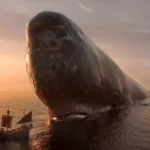
The Laboon sequence is where the new episodes announce what they’re capable of. When Luffy speaks to the whale marooned on the wrong side of Reverse Mountain, the scene earns its sentimentality by grounding it in something concrete. Luffy doesn’t make a speech. He makes a promise, punches the whale’s scar, and tells it to wait.
“People leave, Laboon, But sometimes… you end up somewhere you never thought you would, and you meet people who stay.”
Iñaki Godoy plays the moment without reaching for it, which is harder than it looks. The Rumbar Pirates flashback that follows, a brief glimpse of Brook’s former crew singing Binks’ Brew to the whale before sailing away forever, gives the scene a second layer of grief that the show doesn’t try to explain. It trusts you to feel it.
One Piece Season 2 Character Work: More Room, Better Results
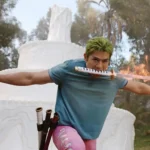
Mackenyu’s Zoro finally gets his showcase. The Whisky Peak fight one man against a hundred Baroque Works assassins inside a multi-story saloon is staged with enough physical confidence that it’s worth pausing on how it works technically. The camera holds on Mackenyu rather than cutting around him. The choreography favors ground-level angles that emphasize momentum over spectacle. When Zoro draws his third sword and grips it between his teeth, there’s no slow-motion underlining. The scene just continues. That restraint makes it land harder.
Jacob Romero’s Usopp gets more to do this season, and the writing gives him room to be both funny and frightened in the same breath. His “You’ll never stop me, creepy Longstocking” line during the Little Garden skirmish is a throwaway gag. Still, it’s the kind of specific absurdity that distinguishes the show when it commits to the source material’s humor rather than sanitizing it. Usopp’s courage, when it finally shows up in genuine form rather than bluster, is more convincing because the show spent time establishing how scared he actually is.
Tony Tony Chopper in Live Action One Piece
The VFX team deserves direct credit here. Chopper works in live action, which was far from guaranteed. What makes him believable isn’t just technical polish; it’s the specificity of his interactions with the human cast. When he first meets Luffy, Chopper physically backs away and then stops himself, caught between instinct and curiosity. His eyes track whoever is speaking to him, adjusting slightly, the way an animal’s attention shifts. Mikaela Hoover’s voice performance maps directly onto that physicality, striking the right balance between childlike and wounded.
The Dr. Hiriluk storyline is the emotional centerpiece of Drum Island, and the adaptation handles it with care. Mark Harelik plays Hiriluk as a man who knows he’s dying but refuses to let those around him know. The dinner scene, in which Hiriluk drinks the poisonous mushroom soup Chopper unknowingly prepared, is quiet and unbearable.
He compliments it. He asks for seconds. When Dr. Kureha later tells Chopper the truth, “He knew it was poison but drank it anyway!” the line hits because the show has shown you what that decision looked like in practice. Hiriluk’s final monologue at Drum Castle, asking “When does a man die? A man dies when he is forgotten,” carries weight because we’ve already seen how he chose to live.
Lera Abova and Charithra Chandran
Lera Abova’s Miss All Sunday is built almost entirely out of what she doesn’t say. The character opens the season by walking through a marine base and killing everyone inside, her Devil Fruit arms appearing from the walls and floors with a matter-of-fact horror that the season wisely doesn’t linger on. Later, in conversation scenes, Abova plays her as someone who is always listening for something specific: a tell, a weakness, a useful piece of information. She’s dangerous because she’s patient, and the show’s writers understood that patience is harder to dramatize than aggression.
Charithra Chandran’s Vivi is the show’s moral compass for most of the second half. The writing gives her a specific tension the anime sometimes smoothed over: she needs the Straw Hats to help her country, but she can’t fully trust them yet. She’s not willing to pretend otherwise. That ambivalence keeps her interesting across multiple episodes rather than collapsing her into a grateful princess.
One Piece Season 2 Production: What’s Actually Different
The cinematography uses wider establishing shots and more location-based compositions than the first season. Season 1 often felt like it was happening on sets, which it was, but the framing confirmed that impression. Here, the outdoor locations on Drum Island and the practical-scale builds of Loguetown create a sense that the world extends past the frame. Directors Emma Sullivan, Josef Kubota Wladyka, Christoph Schrewe, and Lukas Ettlin each bring a slightly different visual sensibility to their episodes. That variance works in the show’s favor. It prevents the Grand Line from feeling like a single continuous location.
Sonya Belousova and Giona Ostinelli’s score gives each island its own musical identity, which is a smarter approach than a single adventure theme would have allowed. Whisky Peak gets a raucous saloon arrangement built around saxophone, the kind of music that sounds like it belongs in the scene rather than over it. Drum Island is strings, sparse and cold. The Laboon theme sits underneath the whale’s flashback sequence like something half-remembered, which is exactly right for a scene about promises made fifty years ago.
Where One Piece Season 2 Falls Short
Luffy’s Gum-Gum powers remain the adaptation’s most visible unsolved problem. The show handles them by minimizing them, which is understandable given the CGI budget required to make rubber-physics look genuinely threatening. Still, it creates a narrative problem: the main character is consistently less visually impressive than his crew.
Zoro’s swordwork, Nami’s staff sequences, and Usopp’s slingshot all read as physically plausible. Luffy’s stretched-limb attacks, when they appear, look like composited additions rather than extensions of what the actor is doing. The Wapol fight in the finale illustrates this clearly: the physical confrontation feels low-stakes in a way that the Whisky Peak battle never does.
The tonal shifts are not always earned. The show quickly moves from broad comedy to emotional devastation, which is faithful to the source material but requires more transition than the writing consistently provides. Hiriluk’s arc lands because the show gave it three episodes. Some other beats Nami’s illness, the giants’ backstory on Little Garden resolve in ways that feel compressed, as if the writers knew they were running short on time and made decisions accordingly.
Chopper’s Heavy Point combat form is the one area where the VFX team’s work doesn’t hold up. The proportions shift between shots, and the creature’s movement feels less integrated with the environment than his smaller forms. Given how well the rest of Chopper works, it’s a noticeable gap.
The early cameos from Bartolomeo, Brook, and Sabo are genuinely fun for long-term fans and genuinely puzzling for everyone else. The show doesn’t explain them, which is a defensible choice; the source material planted these seeds gradually, but it means the new episodes are doing some work for seasons that don’t exist yet.
One Piece Season 2 Adapting the Source Material: What Works, What Doesn’t
The decision to add an original Smoker subplot, in which he investigates Baroque Works rather than simply pursuing the Straw Hats, is one of the adaptation’s better structural choices. It gives the antagonist organization a weight independent of the heroes, and it makes the eventual revelation about Mr. 0’s identity feel like the culmination of something rather than a cold-open reveal.
The Roger and Garp flashback, pulled forward from chapter 551 of the manga to the season’s first episode, is a riskier change. Placed early, it reframes Garp as a man with complicated loyalties before we’ve seen those loyalties tested, which colors every subsequent scene in which he appears. Whether that’s a gain or a loss depends on whether you think dramatic irony or genuine discovery is the better approach for this material. I think it mostly works, though it closes off a surprise that the manga uses to devastating effect.
One Piece Season 2 Verdict
Jeff Ward’s Buggy delivers one line mid-season that probably wasn’t meant to function as an artist’s statement: “The most powerful thing in the world isn’t a weapon or a devil fruit or even a dream. It’s a story.” It’s more self-aware than it needs to be, but One Piece Season 2 backs it up. This is an adaptation that has stopped checking boxes and started making choices, and most of those choices are right.
The new episodes aren’t perfect, and the format constraints are real. But the Laboon scene exists, and the Hiriluk dinner exists, and Lera Abova’s stillness exists. Those are things the first season couldn’t have produced. That’s the difference.
One Piece Season 2 Frequently Asked Questions (FAQ)
Is One Piece Season 2 better than Season 1?
Yes, in most significant respects. The character development is more consistent, the emotional storytelling is more carefully built, and the new cast members, particularly Lera Abova and Mikaela Hoover as Chopper, strengthen the ensemble rather than dilute it. Season 1 built the world; Season 2 uses it.
Is One Piece Season 2 worth watching?
One Piece Season 2 is widely regarded as a worthwhile watch, building on the previous season with a more energetic journey across the Grand Line, strong ensemble performances, and an expansive, sincere interpretation of Eiichiro Oda’s original material.
Does One Piece Season 2 follow the manga?
The new episodes adapt the Loguetown epilogue, Whisky Peak, Little Garden, and Drum Island arcs from Eiichiro Oda’s manga, with several notable changes. These include an original Smoker investigation subplot, early appearances of Bartolomeo, Brook, and Sabo, and a Roger/Garp prison flashback moved up by several hundred chapters from its original placement.
Who are the new characters in One Piece Season 2?
The most significant additions are Lera Abova as Miss All Sunday (later known as Nico Robin), Charithra Chandran as Princess Vivi, Callum Kerr as Marine Captain Smoker, David Dastmalchian as Mr. 3, and Tony Tony Chopper, a CGI character voiced by Mikaela Hoover. All five play major roles in the season’s progression.
How many episodes is One Piece Season 2?
Season 2 consists of eight episodes, released all at once on Netflix on March 10, 2026.
Is One Piece Season 2 suitable for viewers who haven’t seen Season 1?
The new episodes assume familiarity with the Straw Hat crew, the Going Merry, and the events of the East Blue arc. New viewers should watch Season 1 first.
Who composed the music for One Piece Season 2?
The score was composed by Sonya Belousova and Giona Ostinelli, returning from Season 1. Each island location receives distinct musical treatment, with the Laboon material and the Drum Island arc’s sparse string arrangements being particular standouts.
Is One Piece season 3 confirmed?
Yes, season 3 of the Netflix live-action One Piece series has been announced. The third season, titled One Piece: The Battle of Alabasta, has officially concluded filming in Cape Town, South Africa.
Shikhar Jauhari is an entrepreneur, journalist, and digital content strategist with expertise in SEO, WordPress, and online publishing. He is the founder and editor of WRI News, where he covers entertainment, finance, government schemes & lifestyle. With a strong focus on delivering accurate, engaging, and reader-first content, he combines editorial excellence with data-driven SEO strategies to create content.
Over the years, Shikhar has worked as a content writer, editor, website manager, SEO specialist, business analyst, and finance professional for media platforms, businesses, and digital agencies. His experience spans content management, business strategy, taxation, accounting, and digital marketing, enabling him to approach every project with both editorial insight and strategic thinking.