Deer and Loathing in Drum Kingdom Netflix One Piece Live Action Season 2 Episode 8: Review, Summary & Recap
Shikhar Jauhari
August 7, 2026
“Deer and Loathing in Drum Kingdom” is a richly layered season finale that balances slapstick combat, political allegory, and genuine emotional weight. Written by Matt Owens and directed by Lukas Ettlin, the hour delivers on nearly every character arc established across the season while planting a sequel hook that fundamentally shifts the show’s scale.
Netflix’s One Piece live-action adaptation has always asked viewers to accept tonal whiplash as a virtue. “Deer and Loathing in Drum Kingdom” is one of the clearest arguments in the show’s favor. Ettlin’s direction moves from grotesque body horror to slapstick, from political reckoning to emotional release, and keeps most of it airborne because the Drum Kingdom arc was never really just a detour about curing Nami. It was a test of whether this season could make compassion feel as exciting as combat. By most measures, it passes.
Owens’s screenplay anchors the chaos around a clear thematic spine. The Drum Kingdom arc has always been, at its core, about what kind of person gets to hold power and what happens to everyone else when they hold it badly. This finale doesn’t abandon that question at the finish line. It pays it off through action, dialogue, and one packed bag that says more about Kureha than any monologue could.
What does the Wapol vs. Dalton conflict in One Piece Season 2 Episode 8 actually mean?
The opening act belongs to the political confrontation the Drum Kingdom arc has been building since it began. Wapol is not a complicated villain. He is, by design, a petty, cowardly, self-serving tyrant who rules through deprivation a man who expelled all but twenty doctors from the kingdom because monopolizing medicine meant monopolizing control. Dalton, positioned throughout the season as his moral inverse, embodies something the adaptation rarely makes legible: the way systemic cruelty is sustained not by cartoonish evil but by cowardice dressed in royal clothing.
Owens lets this contrast breathe without editorializing too heavily. Wapol’s defeat via the Gum-Gum Air Assault combo is played with the right amount of absurdist finality, punched out of his own castle by a man made of rubber. There is something satisfying about the indignity of it. He doesn’t deserve a climactic duel. He deserves exactly the kind of unceremonious exit he receives.
Dalton’s arc pays off quietly. His exchange with Kureha about the “Will of D.” is one of the finale’s more philosophically loaded moments, a brief, pointed conversation that gestures toward larger mythology without forcing it into the foreground. It lands because the series has earned Dalton as a character; his dignity in the face of Wapol’s rule gives his final moments genuine weight.
How does Vivi’s confrontation with Wapol serve her One Piece Season 2 character arc?
Of all the character payoffs in this chapter, Vivi’s gets the sharpest writing. Her line to Wapol, “It’s time you shut the hell up,” lands not because it’s a bravura action sequence moment, but because the season spent eight episodes establishing exactly why she has earned the right to say it. Vivi is a princess navigating a world that mostly treats her as a diplomatic accessory. Her use of the Peacock Slashers against Wapol is the physical expression of an emotional conclusion: she is no longer waiting to be protected.
Crucially, the script doesn’t position her as suddenly superhuman. The Peacock Slashers require control, finesse, and nerve precisely what her arc has been about developing. Owens uses the action beat to confirm a character shift rather than simply to supply one. That’s why the moment registers as a genuine arrival point rather than a set-piece graft.
What do Zoro, Usopp, Sanji, and Chopper’s fight sequences accomplish in the One Piece Season 2 finale?
Ettlin’s action choreography is where the Drum Kingdom climax most openly flexes its personality. Zoro and Sanji’s contributions are exactly what veteran viewers want: Zoro with maximum competence and minimum commentary, Sanji with maximum commentary and a fighting style that looks choreographed by someone who loves both kung fu films and French bistros. Usopp’s cowardice, deployed as comedy, serves its usual structural function: it makes the bravery of everyone around him feel more earned by contrast.
The monster soldiers Wapol’s Bananawani-fused guard force represent this finale’s most uneven visual territory. The practical and digital effects blend inconsistently, with some shots feeling fully realized and others wearing their budget constraints too openly. This is a production-level issue rather than a creative one; the design work is solid, and the choreography is committed. But the composite work occasionally pulls attention outward in ways that break the otherwise well-maintained immersion.
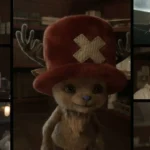
Chopper’s first full-scale integration into the crew’s combat dynamics, on the other hand, is handled with care. Watching him navigate his new role, simultaneously the most powerful and the most emotionally uncertain figure in the fight, gives the action scenes a dimension they would otherwise lack.
How does Sanji’s backstory with his mother deepen the emotional register in One Piece Season 2 Episode 8?
Sanji’s material in “Deer and Loathing” could easily have been fumbled. Instead, the backstory involving his mother is handled with oblique understatement rather than melodrama, and Taz Skylar calibrates accordingly. His line “Every meal I make, I’m making for her” is delivered without theatrical emphasis. It’s quiet. Almost offhand. Which makes it land considerably harder than a scored-up emotional reveal would have.
Beyond simple backstory exposition, the scene reframes Sanji’s entire behavioral pattern across the series. His obsessive care around food, his insistence on feeding people well, his almost ritualistic seriousness about cooking all of it now carries a grief the adaptation never had to spell out explicitly. The audience is trusted to carry that implication forward, which is a form of narrative respect the live-action format often withholds.
What makes the flag scene with Chopper the emotional center of the One Piece Season 2 Episode 8?
Luffy protecting Hiriluk’s Jolly Roger flag and describing it as “a symbol of conviction” is the kind of line that would read as sentimental on paper and somehow becomes genuinely moving in execution. Credit belongs jointly to Iñaki Godoy’s performance, Ettlin’s restraint in shooting the moment, and the structural fact that the audience has been with this flag long enough for the gesture to carry accumulated weight rather than stated importance.
Chopper’s decision to join the crew follows from this moment with an inevitability that feels both surprising and completely correct. His full-name declaration, “My name is Tony Tony Chopper, a name given to me by the world’s greatest doctor,” is the season’s most emotionally complete single line. It’s not triumphant in a traditionally swelling, scored-up way. It’s a statement of identity from someone who spent the entire arc questioning whether his identity was something he deserved to claim.
Luffy doesn’t recruit out of strategy or need. He recruits because he sees people and decides he wants them in his corner. That Chopper is, by multiple narrative logics, the person who should join the crew last this season makes his acceptance feel like the season’s genuine culmination.
Does the Kureha farewell and cherry blossom sequence earn its sentiment in One Piece Season 2 Episode 8?
Yes, specifically because Owens’s script earns it through a single piece of economical characterization rather than by overwriting grief. Kureha’s reveal of a packed bag says everything. She doesn’t need to explain herself. The bag explains her. The cherry blossom sky sequence that follows, scored against the Drum Kingdom backdrop, is visually the season’s most overtly beautiful image, and Ettlin shoots it with enough restraint to prevent it from curdling into excess.
The goodbye works because the arrival did.
How does Lukas Ettlin’s direction shape the episode’s pacing and atmosphere One Piece Season 2 finale?
Ettlin’s instinct for physical and spatial clarity in action scenes, favoring continuity of geography over flashy cutting, means the combat never becomes confusing, even when the hour juggles multiple simultaneous engagements. Drum Castle’s natural vertical architecture gives him plenty to work with, and he uses it to great effect.
Pacing occasionally falters in the midsection, where the adaptation bears the burden of transitioning from combat resolution to the emotional aftermath. Some beats run slightly long, and a tighter editorial hand might have sharpened the momentum. The Baroque Works / Crocodile / Nico Robin reveal at the conclusion, underscored by Dvořák’s New World Symphony, is precisely calibrated, but arriving there requires wading through transitions that don’t always move with the same authority as the surrounding material.
What do the Baroque Works, Crocodile, and Nico Robin reveal mean for the series going forward in One Piece Season 2 finale?
Positioning Crocodile as the approaching threat with Nico Robin revealed as his operative is a statement about what kind of series One Piece intends to become. Drum Kingdom was a contained story about the liberation of a single kingdom. Baroque Works is a conspiracy with continent-level ambitions, and the choice of Dvořák’s New World Symphony as the accompanying score is not incidental. The symphony is traditionally read as a meditation on longing, distance, and belonging in a new world; themes that the reveal immediately activates. The season’s final image is not a resolution but a horizon.
What does “Deer and Loathing in Drum Kingdom” ultimately accomplish for Season 2’s emotional arc?
Chopper sailing away with pirates toward a horizon that didn’t exist for him eight episodes ago that’s the image this season was always building toward. A monster doctor who was never supposed to be a monster, named by the greatest doctor in the world, choosing a crew that chose him first. “Deer and Loathing in Drum Kingdom” earns that image not through grandeur but through accumulation: small, precise choices that arrive in the same emotional key, one after another, until you look up and realize you’ve been quietly wrecked for the better part of an hour.
Deer and Loathing in Drum Kingdom – One Piece Live Action Season 2 Episode 8: Cast
Iñaki Godoy: Monkey D. Luffy
Emily Rudd: Nami
Mackenyu: Roronoa Zoro
Jacob Romero: Usopp
Taz Skylar: Sanji
Charithra Chandran: Miss Wednesday
Mikaela Hoover: Tony Tony Chopper (voice)
Gavin Gomes: Heavy Point Chopper
Lera Abova: Miss All Sunday
Katey Sagal: Dr. Kureha
Callum Kerr: Smoker
Julia Rehwald: Tashigi
Sendhil Ramamurthy: Nefertari Cobra
Yonda Thomas: Igaram
Rob Colletti: Wapol
Tyrone Keogh: Dalton
Mark Penwill: Chess
Anton David Jeftha: K.M.
Aroop Shergill: Young Vivi
Candice van Litsenborgh: Maria
Deer and Loathing in Drum Kingdom – One Piece Live Action Season 2 Episode 8: Crew
Director: Lukas Ettlin
Writing Credits: Eiichirô Oda, Matt Owens, Steven Maeda, Alex Regnery
Producer: Taro Goto, Tom Hyndman, Takuma Naitô, Tatsumi Yoda,
Executive Producer: Marty Adelstein, Becky Clements, Tetsu Fujimura, Steven Maeda, Eiichirô Oda, Matt Owens, Chris Symes, Joe Tracz
Co-Executive Producer: Nic Louie, Ian Stokes, Stephen Welke, Ashley Wigfield
Co-Producer: Robert W. Egami, Lindsay Gelfand, Allison Weintraub
Associate Producer: Gabriel Henrique Gonzalez, Sonia Knape, Corry Turner
Producer (South Africa): Marisa Sonemann-Turner, Rudi Van As
Deer and Loathing in Drum Kingdom – One Piece Live Action Season 2 Episode 8: Other Info
Air Date: 10 March 2026
Run Time: 1h 3m
Distributor: Netflix
Production Co: Kaji Productions, Tomorrow Studios, Shueisha
Special Effects: Framestore
Deer and Loathing in Drum Kingdom Netflix One Piece Live Action Season 2 Episode 8 Frequently Asked Questions (FAQ)
What happens in One Piece Season 2 Episode 8, “Deer and Loathing in Drum Kingdom”?
One Piece Season 2 Episode 8, “Deer and Loathing in Drum Kingdom,” aired on Netflix on March 10, 2026. Written by Matt Owens and directed by Lukas Ettlin, the episode serves as the season finale. It depicts the defeat of Wapol through the Gum-Gum Air Assault combo, Vivi’s confrontation with Wapol using her Peacock Slashers, Tony Tony Chopper officially joining the Straw Hat crew, and a final Baroque Works reveal featuring Crocodile and Nico Robin.
Why does Chopper join the Straw Hats in this episode?
Chopper’s decision to join the crew is catalyzed by Luffy’s act of protecting Hiriluk’s Jolly Roger flag, which Luffy describes as “a symbol of conviction.” This gesture, combined with the acceptance and sense of belonging Chopper finds within the crew, leads him to declare his full name and allegiance. His line “My name is Tony Tony Chopper, a name given to me by the world’s greatest doctor” marks his formal joining of the crew.
What is the significance of the Dvořák New World Symphony in the Season 2 finale?
The use of Dvořák’s New World Symphony during the Baroque Works / Crocodile / Nico Robin reveal signals a major tonal and narrative shift for the series. The symphony, traditionally associated with themes of longing and discovery in a new world, underscores the revelation that a larger, continent-scale conspiracy is approaching the transition from a contained arc into something with far broader implications.
Is One Piece Season 2 Episode 8 a satisfying season finale?
By most editorial measures, yes. “Deer and Loathing in Drum Kingdom” closes the Drum Kingdom arc’s central political and emotional threads, delivers meaningful payoffs for Vivi, Sanji, and Chopper in particular, and establishes a clear and compelling hook for the series’ next phase. The cherry blossom sequence and Chopper’s farewell to Kureha represent the season’s highest emotional register.
What are the visual effects weaknesses in the One Piece Season 2 finale?
The adaptation’s most inconsistent visual effects involve the monster soldiers and Wapol’s Bananawani-fused guard force. The composite digital and practical work in these sequences varies in quality, with some shots feeling well-realized and others visibly constrained by production budget. This is the hour’s clearest technical limitation, though it does not significantly undermine the overall viewing experience.
Who wrote and directed One Piece Season 2 Episode 8?
“Deer and Loathing in Drum Kingdom” was written by Matt Owens and directed by Lukas Ettlin. The episode premiered on Netflix on March 10, 2026.
Shikhar Jauhari is an entrepreneur, journalist, and digital content strategist with expertise in SEO, WordPress, and online publishing. He is the founder and editor of WRI News, where he covers entertainment, finance, government schemes & lifestyle. With a strong focus on delivering accurate, engaging, and reader-first content, he combines editorial excellence with data-driven SEO strategies to create content.
Over the years, Shikhar has worked as a content writer, editor, website manager, SEO specialist, business analyst, and finance professional for media platforms, businesses, and digital agencies. His experience spans content management, business strategy, taxation, accounting, and digital marketing, enabling him to approach every project with both editorial insight and strategic thinking.